The Invisible Crisis: Satellites That Go "Lost"
The story of the satellite industry is increasingly a story of risk. When engineers speak of "lost" assets, they are referring not just to catastrophic failures, but to the exponentially growing amount of non-functional objects that remain in orbit, posing an existential threat to active satellites. The numbers are staggering. While official space surveillance catalogs track over 31,000 objects (larger than a baseball), this represents only a fraction of the problem. According to estimates from the European Space Agency (ESA), there are an estimated 140 million space debris fragments smaller than one centimeter currently orbiting the Earth , objects too small to be routinely tracked, but fast enough to destroy a functioning satellite upon impact.

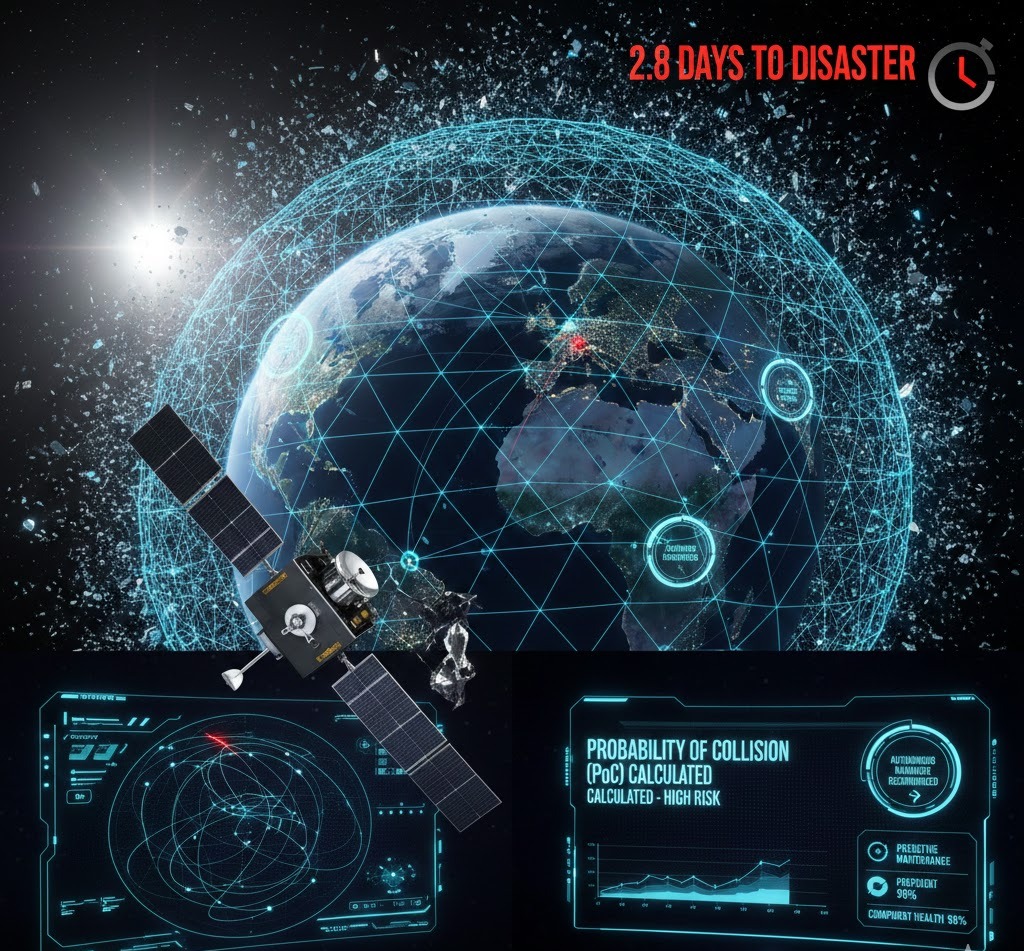
These untracked, "lost" pieces of shrapnel represent a massive collision risk, but the immediate threat is even more dire. The LEO environment is increasingly described as an "Orbital House of Cards-" that is fundamentally unstable. This instability is quantified by the Collision Realization and Significant Harm (CRASH) Clock. Calculations show that if satellite operators were to lose the ability to send commands for avoidance maneuvers, a risk drastically amplified by events like solar storms, a catastrophic collision would occur in only around 2.8 days as of June 2025. This illustrates the immediate, existential danger, representing a catastrophic drop from the 121 days calculated just a few years prior in 2018. A loss of control for even just 24 hours carries a 30% chance of a catastrophic collision, which could initiate the decades-long process of Kessler syndrome.
This dynamic, high-risk environment demands constant, reliable, and instantaneous monitoring of the entire orbital environment , a task that centralized, scheduled government observatories were never designed to handle. Space science must do whatever it can to address this need for advanced, decentralized, AI-based technology.
AI: The Engine Driving SkyMapper’s Continuous Sky Map
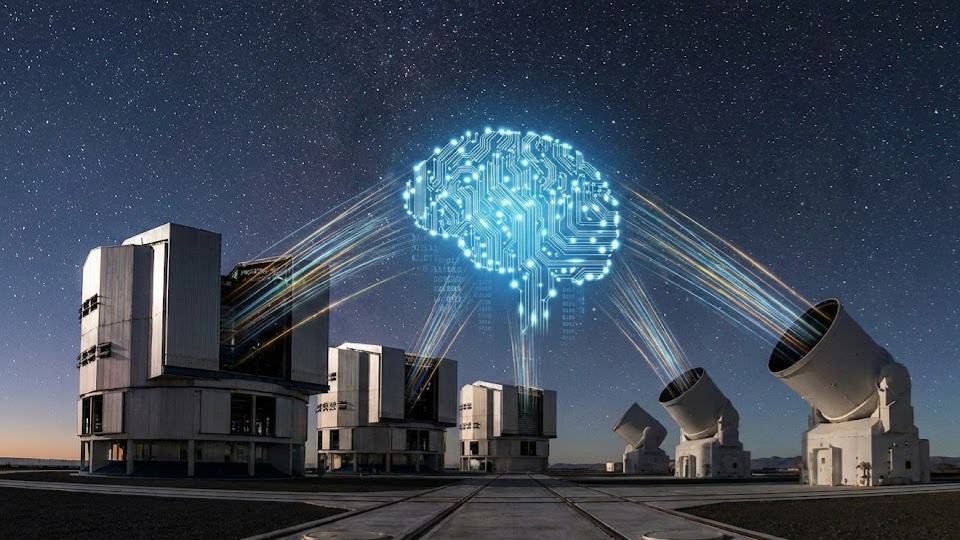
SkyMapper’s solution is a decentralized physical infrastructure network (DePIN) that leverages the collective power of telescopes around the globe. This system is operational 24/7, continuously monitoring the sky, and its core intelligence is powered by AI and machine learning (ML). SkyMapper utilizes onboard ML algorithms within its observation hardware (SkyBridge) to automate telescope control and perform real-time data capture and analysis. This continuous, real-time feedback and control system is precisely what is needed to manage the highly dynamic LEO environment and prevent the "2.8 days to disaster" scenario.
This approach allows the network to:
- Map All the Sky, All the Time: The global distribution of nodes ensures continuous, 24/7 coverage, eliminating observational gaps that allow large debris and non-operational satellites to slip by undetected.
- Assess Collision Risk: The platform is engineered to "Assess Risk of Collisions" by using this real-time, decentralized data to rapidly and accurately calculate the Probability of Collision (PoC) for operators.
- Ensure Data Integrity: By securing every observation on a blockchain ledger, SkyMapper provides an immutable, verifiable source of truth, a vital assurance for high-stakes space traffic management decisions.
This level of continuous, verifiable situational awareness is exactly what the satellite industry has identified as its most critical emerging need.
The Market Research: AI, the Satellite Industry’s Co-Pilot
The role of AI in space is no longer theoretical. A market analysis by MarketsandMarkets confirms that AI is fundamentally reshaping the work of satellite companies across every domain, providing defendable details about its necessity:
AI Applications that Benefit Satellite Companies
Space Surveillance & Situational Awareness: "AI is deemed "indispensable" for automatically detecting and tracking space debris, predicting potential collisions, and recommending avoidance maneuvers."
Autonomous Operations: "AI systems enable satellites to make autonomous decisions (e.g., correcting orientation, adjusting trajectory) and continuously analyze data to predict potential failures, significantly reducing reliance on ground control."
Design & Manufacturing: "AI is used for generative design to create more lightweight and efficient satellite structures, thereby improving payload capacity and reducing costs."
Predictive Maintenance: "Machine learning models analyze sensor data to predict component failures, allowing operators to take proactive measures to extend the lifespan of costly satellites."
The future of satellite operation is autonomous, efficient, and relies heavily on real-time, AI-driven data analysis to ensure system safety and longevity.
SkyMapper: Poised to Support the AI-Driven Satellite Ecosystem
SkyMapper is uniquely positioned to support the needs of these forward-thinking satellite companies by directly addressing the primary pain point identified in market research: Space Situational Awareness (SSA). As mega-constellations grow and orbital congestion accelerates, the constraint is no longer access to space, but awareness of the objects already there. SkyMapper's model provides the continuous, verifiable, and globally distributed data feed required for the next generation of AI-driven space traffic management systems.
By building a real-time, decentralized observation layer, SkyMapper enables commercial operators to:
- Feed their own autonomous systems with highly reliable, third-party verified collision data.
- De-risk future missions by having a complete, continuous map of orbital traffic, vastly superior to intermittent or regionally constrained tracking.
- Protect their multi-billion dollar assets by receiving real-time anomaly detection and incident alerts derived from AI processing across a global network.
The pre-seed funding recently secured by SkyMapper is a clear signal that investors recognize this vital role. As one partner noted, SkyMapper’s approach "creates a new paradigm for the space and satellite industry to monitor and track over $500B of space-based assets". The era of relying on limited, centralized tracking is over. Space science needs to do whatever it can to address the urgent need for advanced, decentralized, AI-based technology, such as those being pioneered by SkyMapper, to secure LEO. The satellite industry’s future is autonomous, AI-powered, and dependent on a global, continuous view of the cosmos. SkyMapper is providing the data to make that future safe and mitigate the 2.8-day disaster scenario.
SZ3 2025