
Hubble Archives to Real-Time Discovery, AI is Decoding the Cosmos
The universe is vast, but our data archives are becoming even vaster. A recent breakthrough from NASA has highlighted a growing truth in modern astronomy: the next great discovery might not come from a new telescope pointing at the sky, but from an AI digging through the data we already have.
This week, NASA reported that a team of astronomers successfully used artificial intelligence to unlock hundreds of "cosmic anomalies" hidden within the Hubble Space Telescope’s massive archive. This success story is more than just a win for Hubble; it is a blueprint for the future of astronomical observation, a future SkyMapper is actively building.
The Hubble "Needle in a Haystack"

For decades, the Hubble Space Telescope has been beaming back images of the cosmos. The result is a staggering repository of data, so much that human eyes literally cannot review it all.
To tackle this, researchers developed an AI algorithm called "AnomalyMatch." By training a neural network to recognize patterns in data (mimicking human visual processing), the tool analyzed nearly 100 million image cutouts in just a few days. The result? It identified over 1,300 odd objects, including gravitational lenses, galaxy mergers, and other rare phenomena that had previously gone unnoticed.
As David O’Ryan, the study's lead author, noted, "Archival observations from the Hubble Space Telescope now span 35 years, offering a rich dataset in which astrophysical anomalies may be hidden."
The Data Deluge is Here

The "Big Data" challenge, exemplified by instruments like the Hubble Space Telescope, illustrates a critical reality in modern science: we are generating information faster than we can analyze it. To find the meaningful "signal in the noise" within these massive datasets, advanced AI tools are no longer optional—they are essential.
At SkyMapper, we are experiencing this necessity firsthand.
Unlike Hubble, which examines the distant past, SkyMapper's decentralized telescope network maps the sky in real-time. In the beta phase alone, our community has gathered over 20,000 observations, accumulating more than 2 terabytes of data.
This vast stream of global network data, transforms into a powerful, navigable river of discovery when strategically managed by Artificial Intelligence. The volume is already formidable: a small SkyMapper beta test yields 2TB of raw data. When thousands of nodes activate globally, the resulting data generation will be fundamentally impossible to process, analyze, or derive meaningful insights from using only traditional computing methods or human effort.
In this context, AI is an absolute necessity. AI algorithms function as the central intelligence, automatically filtering noise, identifying critical anomalies, detecting emerging patterns, and compressing information into actionable intelligence. These engines process petabytes of fast-moving, varied data, into a clear, structured framework. This organized output empowers decision-making and uncovers hidden, overarching truths within systems. Without advanced AI, the immense potential of this global data would be lost, rendering the entire network functionally opaque and its operation unmanageable.
How SkyMapper Uses AI to Sort the Stars
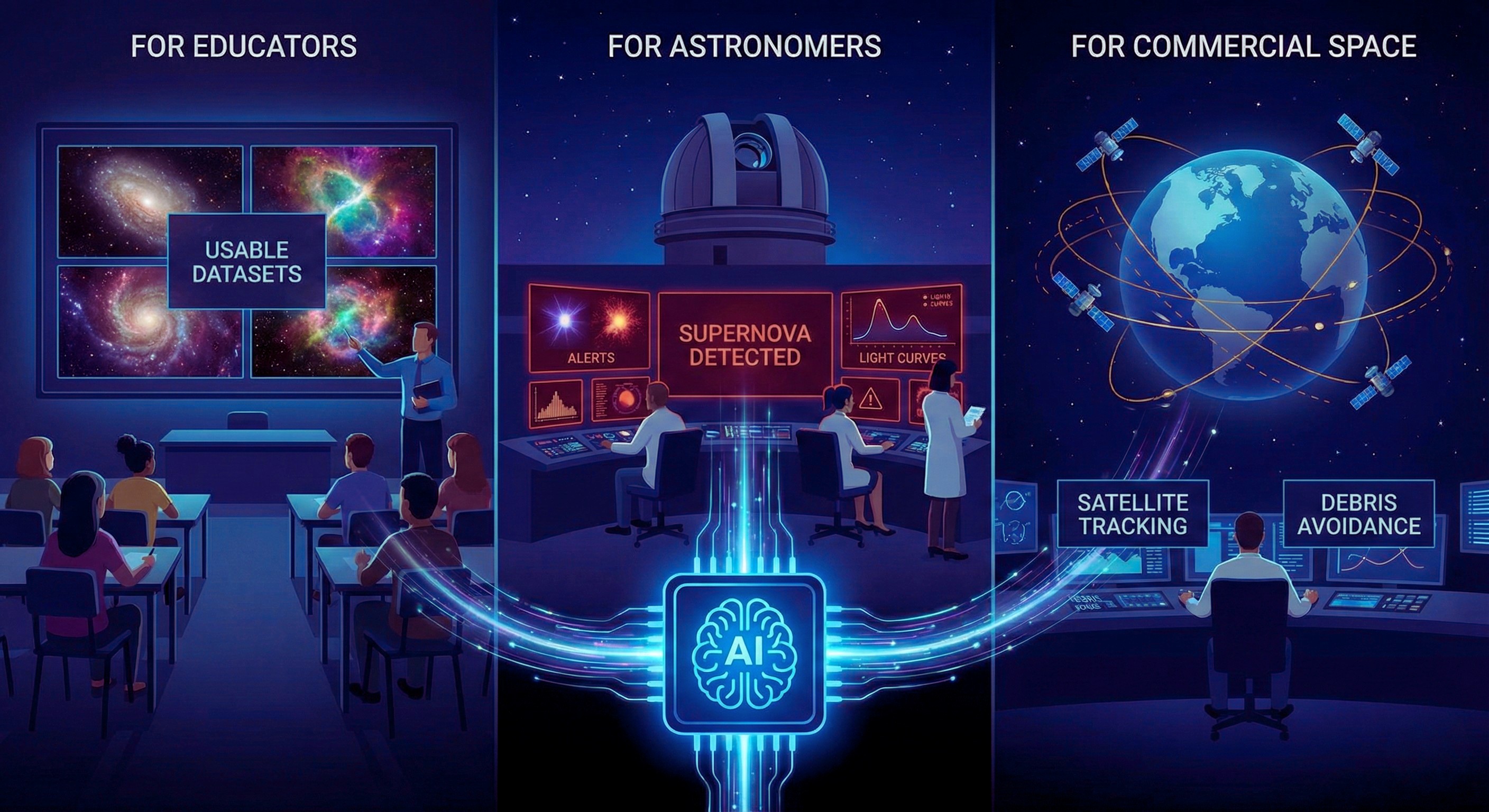
Just as NASA used AI to categorize Hubble’s archives, SkyMapper is leveraging AI to make real-time data useful for three distinct groups:
- For Educators: Raw data can be overwhelming for students. AI tools help process these 20,000+ observations into clear, usable images and datasets, allowing classrooms to engage with the universe without needing a PhD in data science.
- For Astronomers: AI algorithms can instantly sift through thousands of incoming observations to flag transient events, like supernovae or variable stars, alerting researchers to "look here" before the moment passes.
- For the Commercial Space Industry: With Low Earth Orbit becoming crowded, Space Situational Awareness (SSA) is critical. SkyMapper uses AI to track satellites and space debris, distinguishing fast-moving artificial objects from celestial bodies to ensure safety in orbit.
The Future is Automated
The lesson from NASA’s Hubble archive is clear: the universe is full of anomalies waiting to be found. Whether they are hidden in a 30-year-old archive or captured seconds ago by a SkyMapper telescope in your backyard, AI is the key that unlocks them.
At SkyMapper, we aren't just collecting data; we are building the intelligent infrastructure that will help humanity understand it.
Join us as we map all the sky, all the time.
SZ3 2026