.jpg)
Astronomy has entered a radically new era, fundamentally reshaped by artificial intelligence (AI), relentless data flows, and interconnected global infrastructure. Specialized teams and small datasets are no longer the primary means of cosmic exploration. This shift is pronounced in astronomy, where AI and digital platforms have become the central engine for research, discovery, and participation.
From Data Scarcity to Data Deluge
Modern observatories create a data torrent that is physically impossible for humans to process.
Facilities like the Vera C. Rubin Observatory or radio observatories collect thousands of terabytes daily, bring traditional analysis to a breaking point. With this deluge of data, AI is no longer optional, it is essential.
Tasks that once took weeks of manual labor now happen in seconds with AI. Systems monitor incoming data streams, identify anomalies, classify objects, and flag events instantly. Hints of an asteroid, a supernova, or a technosignature no longer sit dormant in an archive, they trigger immediate action.
AI: The Scientific Amplifier
Not only does AI accelerate science, it can also deepen it. AI can clear noise in data, it can enhance image resolution, and it can systematically search decades of archival data to find patterns only visible to a savant. In one recent student project, AI uncovered over 1.5 million new potential astronomical targets, a scale of discovery unimaginable a decade ago.

The integration of AI into research fundamentally changes the astronomer's job description. Astronomers are no longer pipeline writers and data janitors, they are freed to focus on asking sharper questions, designing smarter experiments, and interpreting results with precision. AI does not replace scientists, it elevates them from data processors to system architects and strategic thinkers.
The Rise of Intelligent Telescope Networks
As AI matures, so does the observatory itself. The future is not a single telescope working in isolation, but a distributed, coordinated network of instruments spread across continents, operating continuously and responding dynamically to cosmic events.
When an event such as a satellite maneuver, an occultation, or a transient flash is detected by a modern telescope, AI determines, in real time, the optimal follow-up: which telescope should look next and what instrument is best suited. Manual workflows cannot match this level of automated and learned coordination.
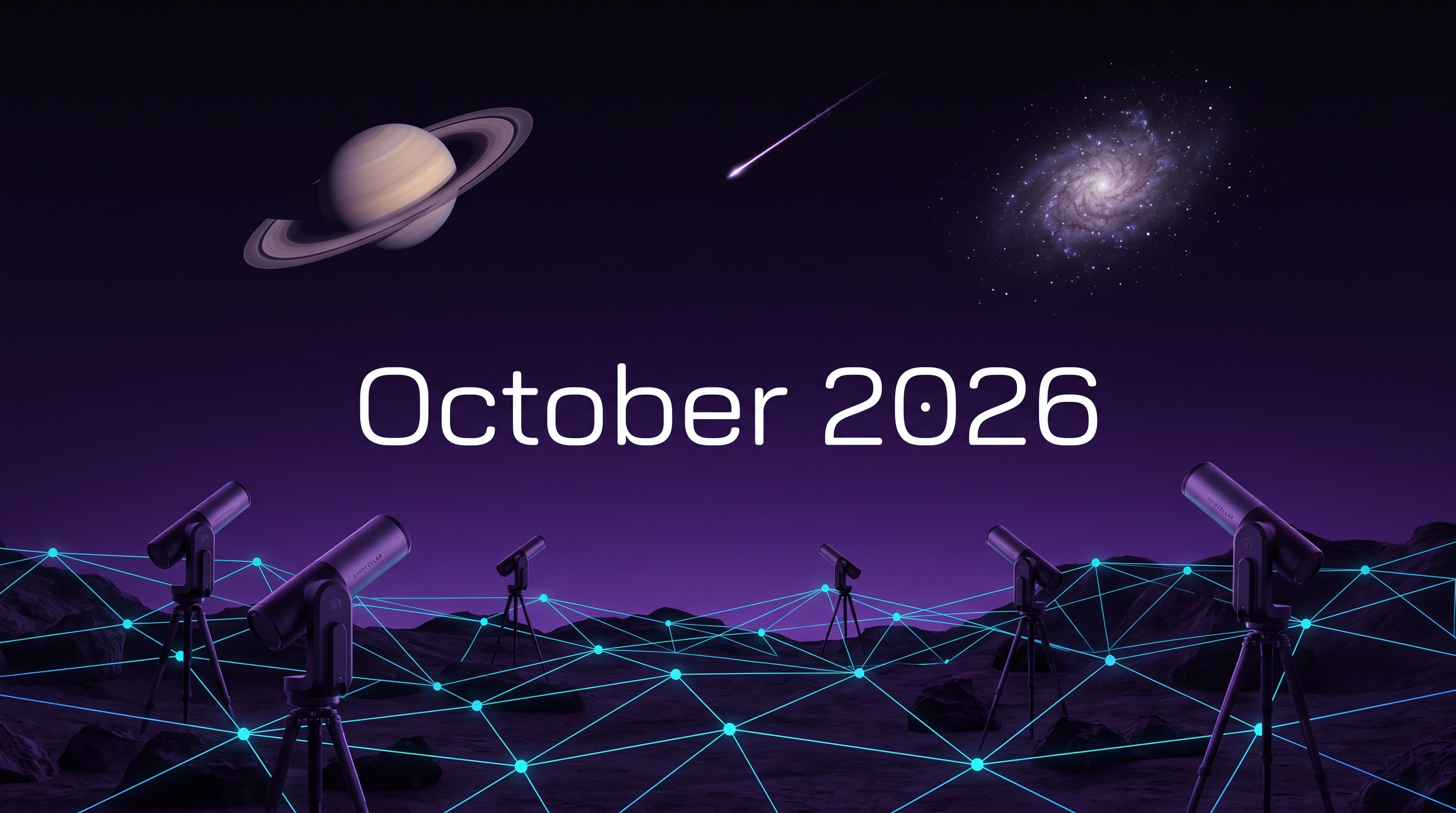
This is the principle behind projects like SkyMapper. SkyMapper is a global, decentralized network connecting professional, robotic, and consumer telescopes into a single AI and machine learning (ML) system. Observations are shared, verified, and acted upon across the entire infrastructure, not isolated in closed silos.
In essence, we are teaching the sky to watch itself.
Real-Time Astronomy is rapidly becoming the industry standard. For example, the Rubin Observatory has the capability to generate tens of thousands of alerts nightly, signaling transient events like near-Earth asteroids, the initial moments of a supernova, or entirely new phenomena.
Integrating a facility like the Rubin Observatory into an AI/ML telescope network, such as SkyMapper's, enables the standardization and implementation of a rapid, collaborative data collection protocol. When the network's AI identifies a high-priority alert within Rubin's data, it can immediately act. This action includes triggering follow-up observations on affiliated telescopes and enabling the Rubin Observatory to instantly share precise coordinates and event characteristics with nearby, specialized observatories and network partners.
This pooling of collective resources to acquire unique data elevates a single discovery into a global, multi-instrument campaign through rapid, coordinated communication. For global telescope networks like SkyMapper’s, AI triages these alerts, distinguishing the extraordinary from the routine, to instantly initiate rapid follow-up. The ultimate goal is simple: to transition from simply observing more to observing smarter.
Over time, these systems will achieve true ML autonomy by learning from past data, optimizing their own usage, and proposing entirely new observing strategies.
Democratization Through Digital Infrastructure
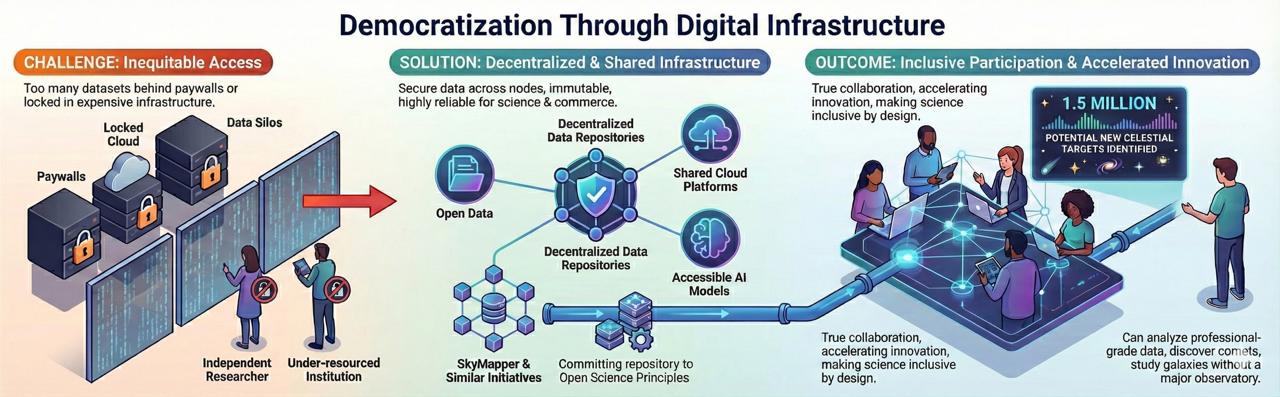
The most significant transformation with astronomical AI and telescope networks may be who gets to participate.
With open data, cloud platforms, and accessible AI models, a student anywhere in the world can analyze professional-grade data with only a laptop and an internet connection. They can discover comets or study galaxies without ever needing to step inside a major observatory, as seen in the aforementioned student project that identified 1.5 million potential new celestial targets.
Access to current astronomical data remains inequitable. Too many datasets are still behind paywalls or locked in expensive cloud infrastructure, limiting participation from independent researchers and under-resourced institutions. This is why decentralized data repositories and shared infrastructure are crucial. Decentralized data repositories secure data across several nodes and render data immutable, making the data highly reliable for use in both science and space commerce.
SkyMapper and similar initiatives create a network repository that goes beyond the confines of one institution, committing to open science principles combined with modern digital infrastructure. By eliminating data silos, true collaboration can occur, accelerating innovation and making science inclusive by design.
A Faster, Smarter, More Inclusive Future
AI is fundamentally transforming astronomy, not by replacing human effort, but by amplifying human curiosity globally.
The future of discovery lies in AI-integrated, global telescope networks; we can process a greater volume of data, react instantly to unexpected events, and conduct truly collaborative science, allowing us to collect data faster and process it smarter and more strategically.
Ultimately, this empowers everyone, from citizen scientists to startups and space agencies, to participate in the act of discovery to answer humanity's deepest questions about our origins, the cosmos, and life beyond Earth.
SZ3 2025