

It has been a rough few days for anyone who relies on critical American infrastructure.
On Friday, November 13, a single malfunctioning router in Arkansas overwhelmed the Federal Aviation Administration's communications network. The data flood disrupted air traffic control centers across the country and forced an emergency nationwide ground stop that stranded thousands of flyers. As CNET reported on the FAA router incident, aviation experts were stunned that a routine hardware replacement at one facility could ripple across so much of the national airspace, a point echoed in WXXI News coverage of the fallout.
Before travelers had even finished rebooking their flights, the financial system hit its own wall. On Monday morning, November 16, a software bug inside a local server system at JPMorgan Chase began stalling online banking and payment transfers. Because Chase clears transactions across the wider banking network, the glitch spilled over to customers at Bank of America, Wells Fargo, and U.S. Bank. Both CBS News and TIME detailed how thousands of everyday users were locked out of checking balances or sending money through Zelle for hours.
Then, on Tuesday, November 17, breaking reports revealed that NSA Net, the highly classified internal network intelligence officers use to share sensitive information, had gone dark. According to CNN and The Record, the outage forced the National Security Agency to stagger employee arrival times during a busy week of diplomatic travel in Asia.
The strangest part of this entire sequence is what did not happen. None of these crises were caused by foreign hackers or coordinated cyberattacks, that we know of. As Insurance Business noted in its breakdown of the week's outages, every single failure came down to ordinary technical glitches inside centralized systems.
When the best funded institutions in the country can be knocked offline by a bad router or a localized software bug, we have to ask a basic question: why are we still trusting centralized hubs to hold and protect our most important data?
Why Centralized Networks Keep Breaking
For decades, banks, airlines, and government agencies have built their digital infrastructure around central hubs. Massive data centers and top down routing setups are convenient for administrators, until something goes wrong. As TechRepublic recently pointed out following major cloud disruptions, when essential tools depend on a single underlying provider or hub, one local mistake cascades everywhere.
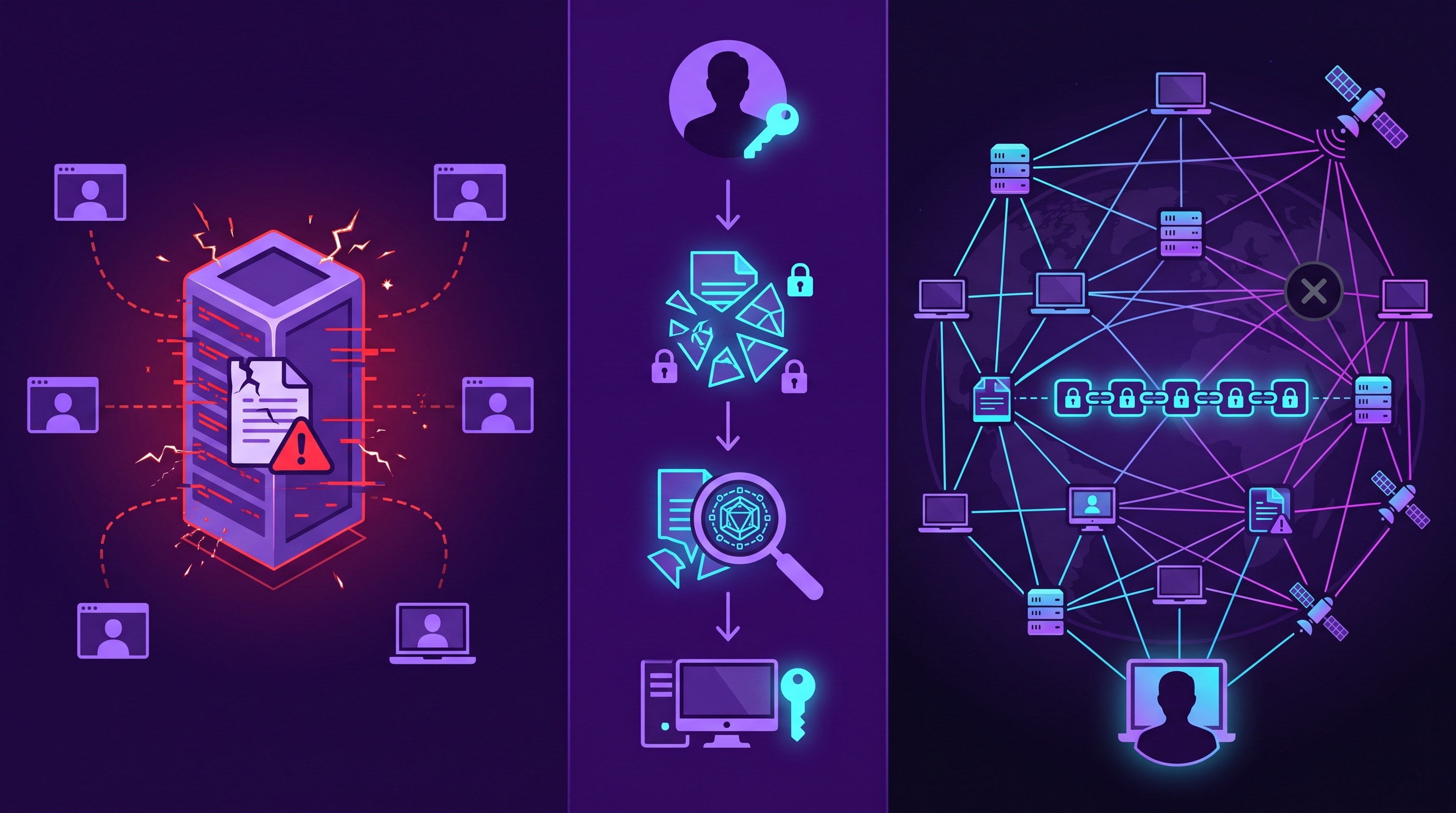
The biggest flaw with this setup is that one glitch quickly becomes everyone's crisis. When thousands of local terminals rely on a central router or server cluster, a minor hardware hiccup turns into a nationwide bottleneck because there is nowhere else for the traffic to go.
Beyond outages, centralized databases are fragile and hard to verify. Storing sensitive records behind a single institutional gatekeeper creates an obvious target for ransomware, insider tampering, or silent data corruption. Worse, if that central database goes dark or alters a record, everyday users have no independent way to prove what the original file looked like.
Finally, traffic bottlenecks slow down urgent data. Pushing high volume sensor feeds, imagery, or operational logs to one central server creates lag. When you are monitoring aircraft, satellites, or emergency events, waiting on a distant server to ingest and process incoming data leaves dangerous blind spots.
How Decentralized Networks Protect Your Data
Decentralized networks solve these problems by removing the middleman and spreading the workload across many independent machines around the world. Instead of placing blind trust in a single corporate server room, decentralized infrastructure relies on distributed storage and math you can verify yourself.
Because workloads are distributed, there is no single point of failure. In a decentralized network, files are encrypted, broken into smaller pieces, and spread across independent nodes in different locations. If one server loses power or an entire regional data center goes offline, the rest of the network keeps serving your data without missing a beat.
That resilience pairs with mathematical proof instead of blind trust. Rather than asking you to take an administrator's word that a file has not been touched, decentralized networks record cryptographic fingerprints onto an immutable ledger. Change even a single pixel or timestamp, and the math immediately flags the tampering.
Most importantly, you keep control of your identity and data. Cryptographic keys allow people to authenticate and share their data streams without handing over sensitive personal information to a central database that could leak or go offline later.
How SkyMapper Secures Your Data From Start to Finish
At SkyMapper, we are building a community powered network for continuous sky observation, satellite tracking, and low altitude airspace awareness. When you are tracking objects in orbit or monitoring local airspace, downtime and tampered records simply are not options. We designed SkyMapper from the ground up to avoid every trap of centralized infrastructure.
Sealing data on the hardware at the edge (SkyBridge and SkySphere)
Security starts before your data ever touches the internet. Whether you connect a smart telescope through SkyBridge or run a full sky SkySphere sensor array, processing happens locally on the device itself. Every captured frame is stamped with authenticated GNSS time and location metadata right away, while an internal hardware security chip generates a unique cryptographic hash on the spot. That locks in the chain of custody at the point of origin, stopping interception or spoofing before transmission even begins.
Recording tamper resistant proof on an Avalanche Subnet
Once an observation is sealed, SkyMapper logs its unique ID, cryptographic fingerprint, and signed metadata onto a dedicated, permissioned Avalanche Subnet using our Proof of Space Origin system. By keeping heavy raw image files off chain while storing lightweight cryptographic proofs on chain, verification stays fast and congestion free. Researchers, regulators, and operators can check the ledger at any time to confirm that a file matches the exact observation captured by the sensor.
Spreading encrypted files across Akave Cloud
Your raw imagery and telemetry never sit on one vulnerable server. SkyMapper partners with Akave Cloud for decentralized storage, encrypting your files. Each file is split into multiple blocks ≤1 MB in size and redundant blocks are generated for error correction, after which all blocks are uniquely encrypted and distributed across separate, geographically-dispersed storage nodes. Even if multiple nodes go offline at the same time, your data remains completely intact and recoverable, delivering “11 nines” of durability.
Keeping user identity private inside SkyViewer
When operators log into the SkyViewer dashboard, they can sign in using a Web3 wallet like MetaMask alongside standard login options. Cryptographic keys separate your real world identity from public telemetry feeds, giving you direct control over your observations while keeping every contribution to the network transparent and verifiable.
The back-to-back outages at the FAA, JPMorgan Chase, and the NSA are a clear reminder that throwing more money at aging, centralized hubs will not fix an architectural flaw. True resilience comes from spreading the load, verifying data mathematically, and eliminating single points of failure. By combining edge hardware sealing, immutable blockchain proofs, and erasure-coded decentralized storage, SkyMapper keeps your data accurate, tamper resistant, and always online.
Ready to join a network built without single points of failure? Explore how you can connect your telescope or deploy SkySphere sensors at skymapper.io.