

SkyMappers and fellow stargazers, this week, we recommend trading our deep-sky targets for a piece of modern aerospace intrigue: China’s highly classified space plane, Shenlong, is making a series of visible dawn passes over the United States.
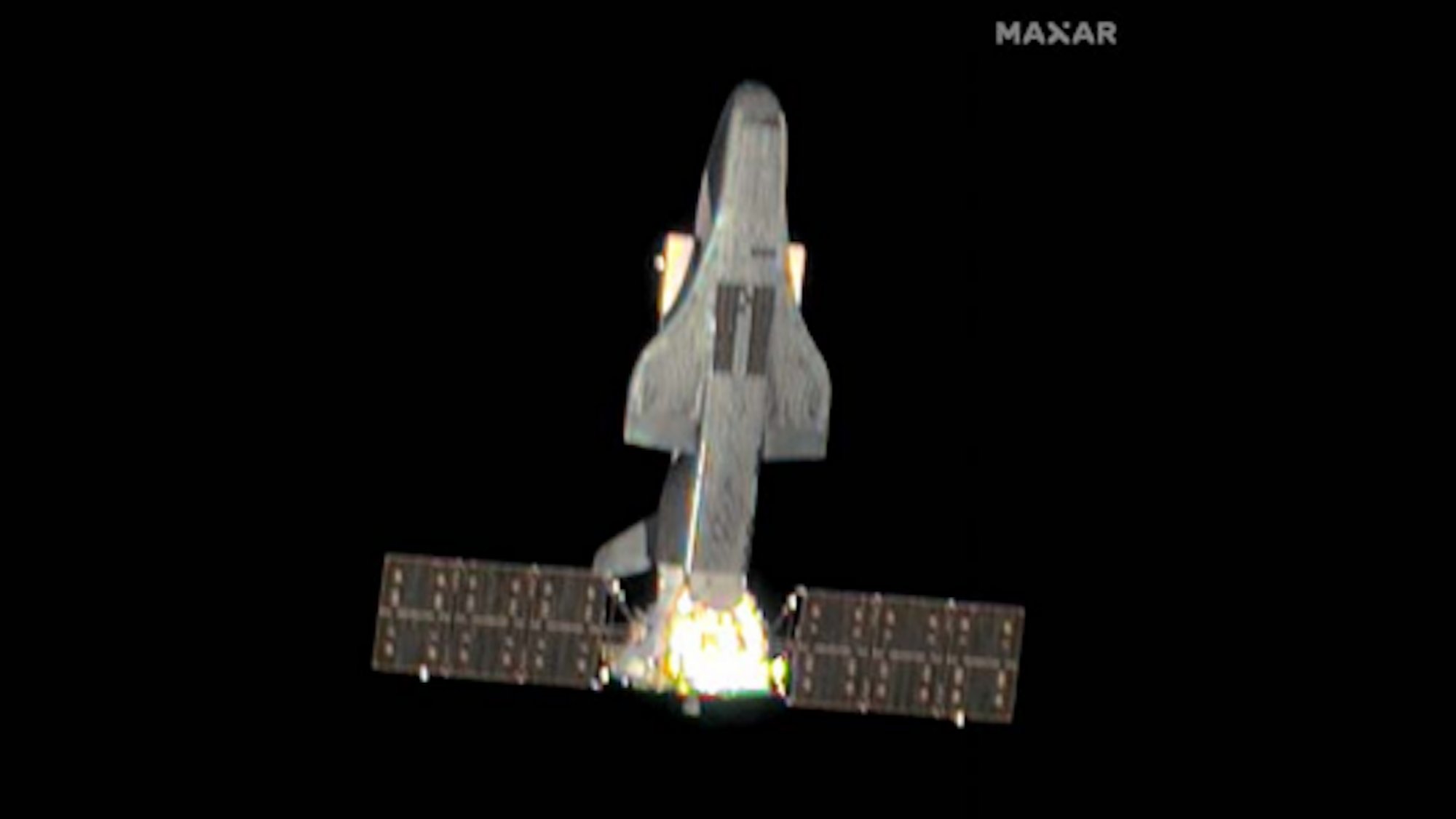
For those who haven't been following the latest orbital maneuvers, Shenlong, which translates to "Divine Dragon", is a reusable, uncrewed space plane conceptually similar to the US military’s X-37B. The enigmatic craft is currently executing its fourth classified mission. The intrigue deepened recently when the US Defense Intelligence Agency released a remarkably clear unclassified photo capturing Shenlong in orbit, prompting a surge of interest among amateur astronomers. According to a recent stargazing report by Space.com, the spacecraft is now gliding right over our backyards, presenting a rare opportunity to observe it in action.
Tracking Shenlong with the Naked Eye
To the unaided eye, Shenlong will appear as a small, steadily moving point of light, crossing the starry canvas much like a standard satellite. Because the space plane's brightness fluctuates depending on how sunlight catches its hull, you will need favorable conditions to spot it. As noted by Space.com, veteran satellite observer Paul Maley recently noted that Shenlong can peak at a moderately bright magnitude of +2.5 to +3.5, but can quickly dim down to a faint +6.
Your absolute best bet is to seek out dark, moonless skies far away from city light pollution. Allow your eyes twenty minutes to adapt to the dark, and bundle up for the predawn chill. To pinpoint the exact time and maximum elevation of Shenlong's flyovers for your local area, the Space.com guide recommends utilizing the satellite tracking website Heavens-Above. Simply enter your coordinates and search their satellite database for PRC TEST SPACECRAFT 4 to generate a precise sky chart.
Capturing the Dragon Through Your Telescope
If you want to go beyond naked-eye observation and actually capture imagery of the spacecraft's hull or solar arrays, a standard tripod and DSLR won't cut it for resolving details, you need to integrate your telescope with active satellite tracking. Shenlong moves incredibly fast across a narrow field of view, making manual tracking is nearly impossible.
To properly photograph the space plane, you will have more success using a motorized tracking mount equipped with an ASCOM interface, to continuously track the vessel's real-time trajectory.
Telescopes equipped with a high-frame-rate planetary or astrophotography camera (such as a ZWO ASI series) will have luck capturing this vessel. Instead of taking long exposures, which will just result in a white streak across your image, record a continuous high-speed video at 50 to 100 frames per second with very short exposures as the mount tracks the craft. Once you review your video files, you can use stacking software to extract the sharpest fractions of a second where the atmospheric seeing stabilized. With precise focus and a bit of luck, this "lucky imaging" technique can reveal the distinct structural shape of the space plane itself.
Set those early morning alarms, calibrate your tracking mounts, and get ready to witness a piece of classified aerospace history sailing through the dawn. Happy hunting, and as always, keep looking up!
sz326