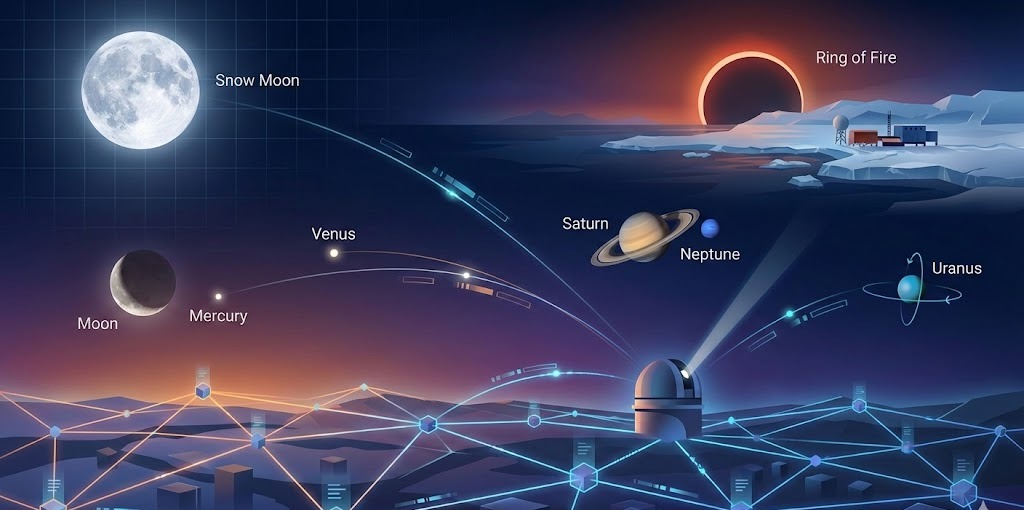
If you’ve been following the celestial forecast, you know that February 2026 is shaping up to be a spectacular month for skywatchers. From the “Snow Moon” to a lonely “Ring of Fire” eclipse over Antarctica, the schedule is packed.
But at SkyMapper, we look at the night sky a little differently. While we never tire of the beauty above, it is important to remember that we are, first and foremost, a science organization. We don't just watch the stars; we measure them. We verify them. And through our decentralized network, we turn every observation into a data point on an immutable ledger.
As you head out this month, here is how to view the upcoming events not just as a sightseer, but as a participant in a global scientific endeavor.
Precision in Motion: The Moon Meets Regulus (Feb. 2)
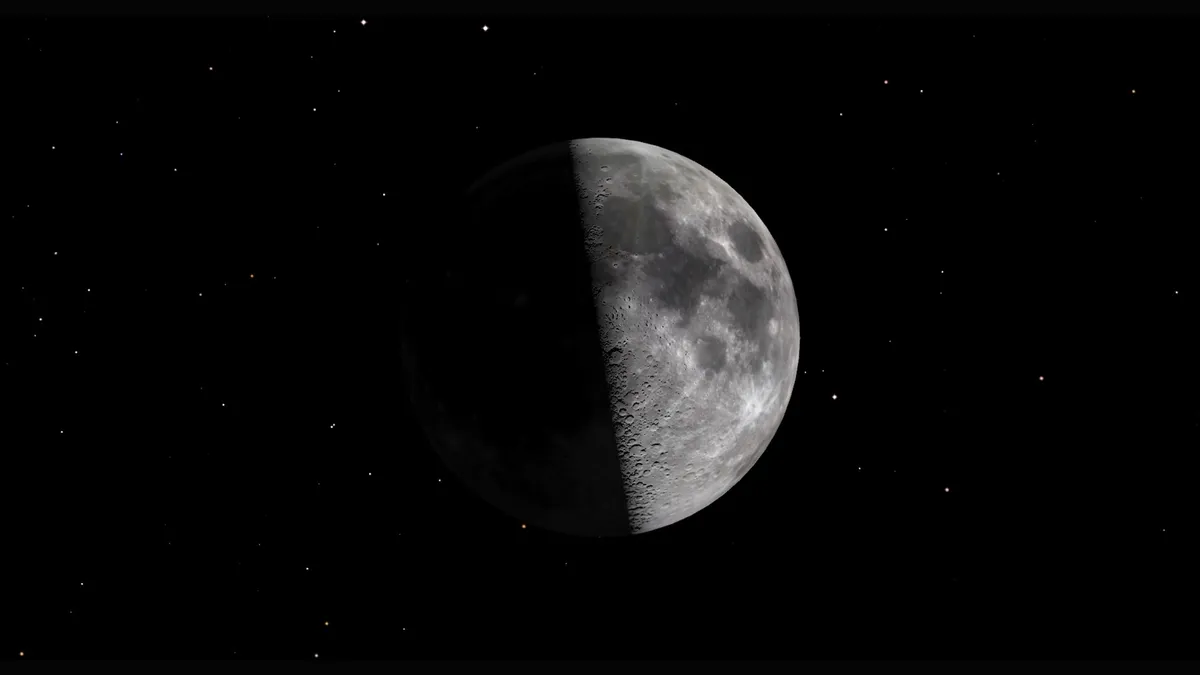
Right out of the gate, the universe offers a masterclass in celestial mechanics. On the evening of February 2, the waning gibbous Moon will pass directly in front of Regulus, the brightest star in Leo.
For a casual observer, it’s a beautiful conjunction. For a scientist, an occultation like this is a critical event. Historically, timing exactly when a star disappears behind the lunar limb helped astronomers refine the Moon's orbit and detect the presence of binary stars. Today, it serves as a reminder of the clockwork precision of our cosmos, precision that SkyMapper’s network relies on to validate data across the globe.
The Mechanics of the Solar System
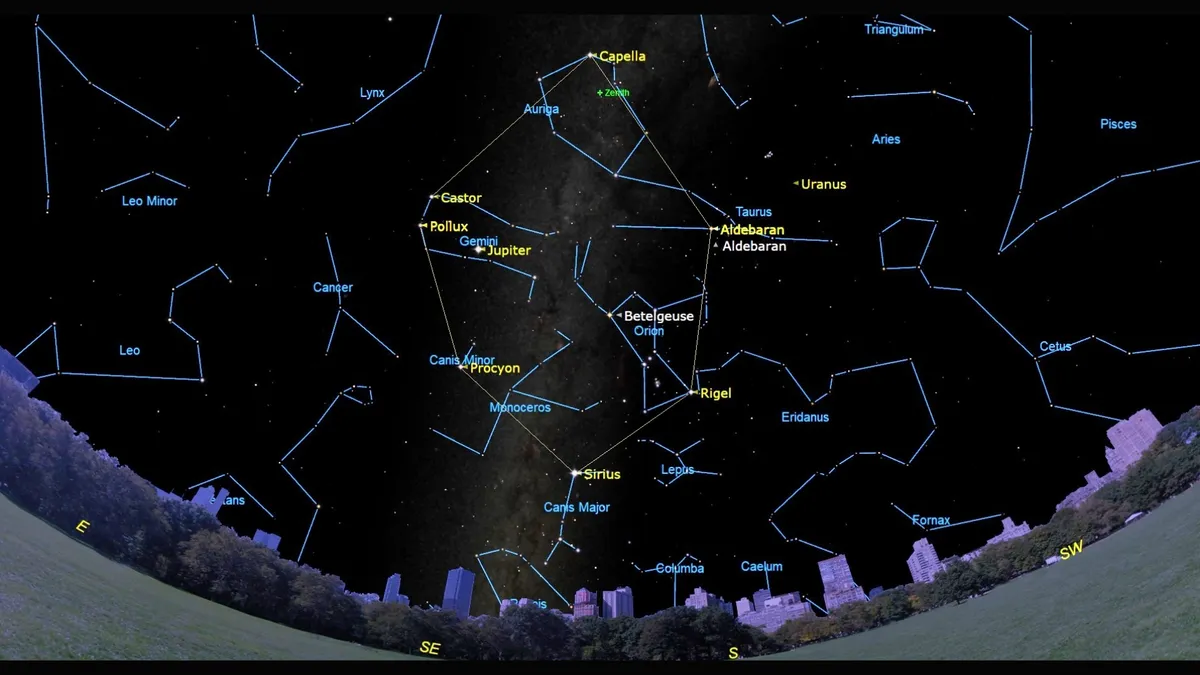
Later in the week, on February 4, Uranus completes its retrograde loop and stands still against the background stars of Taurus before resuming its eastward march. It’s a subtle shift, visible only to those tracking the data over time, exactly the kind of "slow science" that builds a robust understanding of planetary orbits.
Then, from February 16-20, we get a challenge for our optics: Saturn and Neptune will appear less than a degree apart. While Saturn is bright and easy to spot, Neptune requires binoculars or a telescope. This conjunction is more than a beautiful sight; it's a solar-system-scale demonstration of cosmic depth perception, allowing you to witness the giant, ringed world of Saturn contrasted with the faint blue dot of the ice giant Uranus, which lies billions of miles further into space..
The "Lonely" Ring of Fire (Feb. 17)
The headline event of the month arrives on February 17 with an Annular Solar Eclipse. However, this "Ring of Fire" will be visible almost exclusively from Antarctica and the Southern Ocean.
Why does this matter to a decentralized network? Because science doesn't stop where the people are. A solar eclipse in the most remote place on Earth is still a massive stress test for our orbital models. When the shadow touches the ice at the exact second predicted, it validates the mathematics we use to navigate spacecraft. It is a testament to the "truth" of physics, a truth SkyMapper aims to preserve on the blockchain.
Inner Solar System Geometry (Feb. 18-28)
The month closes with a flurry of activity in the western sky:
- Feb 18: A young crescent Moon joins Mercury and Venus.
- Feb 19: Mercury reaches its greatest eastern elongation, offering the best data-collection window for the innermost planet.
- Feb 28: As the month ends, Mercury passes close to Venus, while the Moon sweeps past the Beehive Cluster (Messier 44).
Your Data, Verified.
Whether you are tracking the retrograde motion of Uranus or timing the occultation of Regulus, you are witnessing the raw code of the universe.
At SkyMapper, our mission is to ensure that this data, whether from a professional observatory or a backyard telescope, is captured, verified, and stored securely. We believe that the truth of what happens in our sky belongs to everyone, and its provenance should be undeniable.
So, enjoy the Snow Moon and the planetary alignments. But as you look up, remember: you’re looking at the world’s largest laboratory.
To learn more about what to see in February, check out this more thorough article sourced from: Space.com - Night sky, February 2026: What you can see tonight
SZ3 2026