The increasing density of satellites, debris, and transient events means the sky is more complex and scrutinized than ever before. SkyMapper addresses this complexity by creating a shared observatory, a unified, verifiable record of the sky at any given moment.
This is made possible by the Akave Cloud (Akave), which acts as the crucial storage backbone for SkyMapper's global network of telescopes and all-sky cameras. Akave is essential for leveraging the network's redundancy and guaranteeing data integrity.
Every image captured is stored on Akave's decentralized platform with cryptographic provenance. This process transforms a simple upload into verifiable proof. The immutable metadata details the image's origin and capture time, guaranteeing it has not been tampered with. In essence, Akave ensures the observation is not just plausible, but demonstrably provable: "This is the exact, unaltered image the telescope recorded at that specific moment."
From "We saw it" to "We Can Prove It"
Traditional astronomy operates on a model of institutional trust, where results from a single observatory are accepted. This system of reliance on a solitary source breaks down when observations are generated by a worldwide network of community telescopes. This network offers constant observation and validation, with data gathered from diverse locations and perspectives.
SkyMapper operates a globally interconnected network of strategically positioned telescopes. This orchestration network ensures significant redundancy: a transient object captured in Chile can also be visible from New Zealand and Hawaii; a satellite seen crossing a frame in Los Angeles is observable again minutes later from Europe. The power of this redundancy relies entirely on the underlying data being consistent, tamper-proof, and fully traceable.
The core of our credibility model is community-powered observation. Precision is achieved through comprehensive geographic coverage, as multiple angles on the same event yield superior data. Every addition to the system, from a university rooftop node to a dedicated SkySphere mount, enhances the collective strength. This distributed network shifts verification to an infrastructure level, moving beyond sole reliance on institutional reputation. Raw observations are made universally accessible to professional astronomers, citizen scientists, and researchers, all anchored by shared, blockchain-secured metadata.
Akave capitalizes on this redundancy. Each frame generated by a SkyMapper device is stored in decentralized storage, complete with cryptographic provenance. This immutable metadata verifies the frame's origin, capture time, and integrity, transforming the simple statement "Someone uploaded this" into proof that "this is the exact, unaltered image the telescope recorded at that specific time."
How the Joint System Works
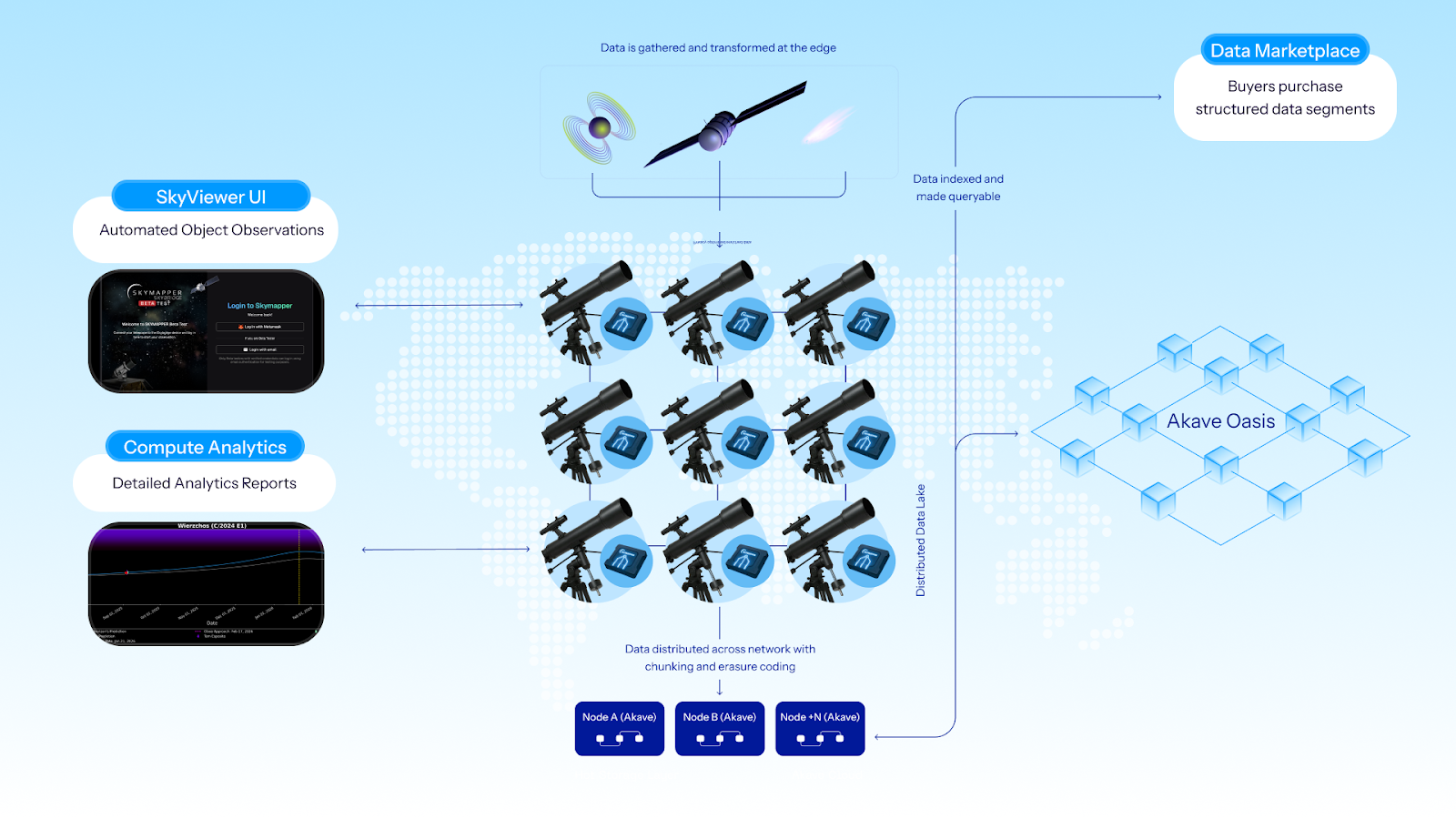
At the core, SkyMapper runs SkyQueue, an automation and orchestration layer that keeps telescopes productive all night:
- Checks which telescopes are on-sky
- Selects targets from transient alerts, satellite passes, and comet ephemerides
- Schedules observations and records image sequences
- Pushes data through AI models that classify what was seen
Once observations are ready to store, Akave takes over:
- SkyMapper devices send data through an S3-compatible endpoint.
- Akave encrypts and shards the data using RS(32,16) Reed–Solomon erasure coding (32 data fragments, 16 parity fragments).
- Shards are stored across a decentralized network of nodes. Verification metadata and erasure set commitments are written on-chain so any reader can prove integrity without moving the raw images.
Why Decentralized Storage Fits a Decentralized Sky
The SkyMapper network is built on a deliberately distributed architecture. Its telescopes are installed on rooftops, in observatories, and on specialized SkySphere mounts globally. Every new node added to the system enhances both the network's overall coverage and its resilience.
Centralized storage would collapse that model. It reintroduces the bottlenecks SkyMapper is intentionally avoiding:
- Potential censorship attempts
- One institution becomes gatekeeper for access
- One failure domain can take the archive offline
- One security perimeter becomes the only line of defense
Distributed science demands trust, a guarantee lacking in centralized systems. These traditional models are slow, hampered by fixed schedules and bureaucratic oversight. Furthermore, access is often restricted by institutional politics or subscription fees. Finally, a single database is a vulnerability: data is susceptible to alteration, making authenticity disputes impossible to resolve.
Akave mirrors SkyMapper's topology at the storage layer. Observations go into verifiable object storage with no single point of failure. SkyMapper's Proof of Spatial Observation (PoSO) verifies that each submission comes from a validated location, time, and sensor source. False coordinates, duplicates, and synthetic imagery are rejected at this validation stage. Akave then stores the verified data immutably, extending the chain of proof into the storage layer.
More coverage leads to higher accuracy, which drives more data demand, which funds more node deployments. Educators in one region, researchers in another, and SkyMapper's own pipelines all read from the same cryptographically proven data set. Not a fragile cluster behind one organization's firewall.
What Changes for Astronomers and Educators

For astronomers working on orbit determination and transient follow-up:
- Satellite detections derived from SkyMapper astrometry come with a clear chain back to the raw frames
- Multi-station observations can be combined without debating whose copy of the data is authoritative
- Re-analysis years later starts from the original pixels, not a compressed export passed around in archives
For educators running SkyMapper sessions in classrooms:
- Students can compare their own observations against the network record and see how their local sky fits into the global picture
- Instructors point classes to a durable, verified archive instead of managing local storage
- Satellite companies can track their satellite orbits with real-time updates
For the SkyMapper team:
- Operational focus shifts from "keep disks alive" to "keep telescopes on-sky"
- Audit trails for firsts – first satellite orbit from the network, first comet pipeline, first bot-posted result – are backed by storage that can prove each claim
Benefits of the Integration

Verifiable Observations
Every stored frame has cryptographic provenance. When a SkyMapper telescope contributes to a published orbit or transient discovery, the underlying data is defensible.
Real-Time Response That Persists
The network already responds to events in under two minutes, and SkySphere cameras routinely capture frames in 100 ms. Writing into Akave means those real-time captures do not live only in local buffers. They become part of a durable record almost as quickly as they are taken.
Durability Aligned with the Science
A once-per-lifetime comet appearance or a meteor trail at 3:47 AM cannot be reshot. Akave's 11 9s durability and RS(32,16) erasure coding align with that reality. The data is treated as irreplaceable from the moment it arrives.
Shared Access Without a Single Gatekeeper
Because observations are stored in a decentralized network rather than one institution's servers, access can be tuned to the community SkyMapper is building. Researchers, educators, and citizen scientists read from the same verified data without having to route through a central IT team.
About the Companies
Akave Cloud is an enterprise-grade, decentralized object storage platform for verifiable, compliant, and cost-efficient data retention. It provides a fully S3-compatible interface, an immutable ledger for auditability, erasure-coded redundancy, and client-side encryption. The O3 gateway enables deployment anywhere while maintaining sovereignty, verifiability, and interoperability with existing tools.
SkyMapper is building the world's first decentralized, real-time telescope network. The beta testing includes telescopes and SkySphere all-sky cameras deploying globally via SkyBridge devices. SkyQueue automation processes transients, satellites, and comets with AI classification. SkyChain provides proof-of-Space-Observation for blockchain anchoring. The mission: transform the sky into a shared observatory accessible to everyone. To join the mission, contact SkyMapper.
SZ3 2025