This March, the cosmos is putting on a high-definition show, and if you’ve been waiting for a reason to dust off your primary mirror, this is it. At SkyMapper, we believe the sky isn't just a static view—it's a dynamic network of events happening in real-time. Whether you’re a backyard enthusiast or a node in our decentralized global network, March 2026 offers rare targets that demand the precision of a telescope.
From a "Blood Moon" to a "Planet Parade," here are the top observable events to track this month.
1. The "Blood Moon" Total Lunar Eclipse (March 3)
The month kicks off with a bang. On the night of March 2 into the morning of March 3, the Earth will slide directly between the Sun and the Moon.
- The View: Watch through your eyepiece as the lunar surface transitions from brilliant white to a deep, eerie copper-red.
- Telescope Tip: Use a wide-field eyepiece to capture the entire disk. During totality, look for the subtle color gradients, often referred to as the "Danjon Scale", which can range from bright orange to nearly black depending on Earth’s atmospheric dust.
- Why it Matters: This is the last total lunar eclipse for nearly three years. If you’re a SkyMapper contributor, this is a prime opportunity to capture high-resolution imagery for our blockchain-verified gallery.
2. The Great Six-Planet "Parade" (Early March)
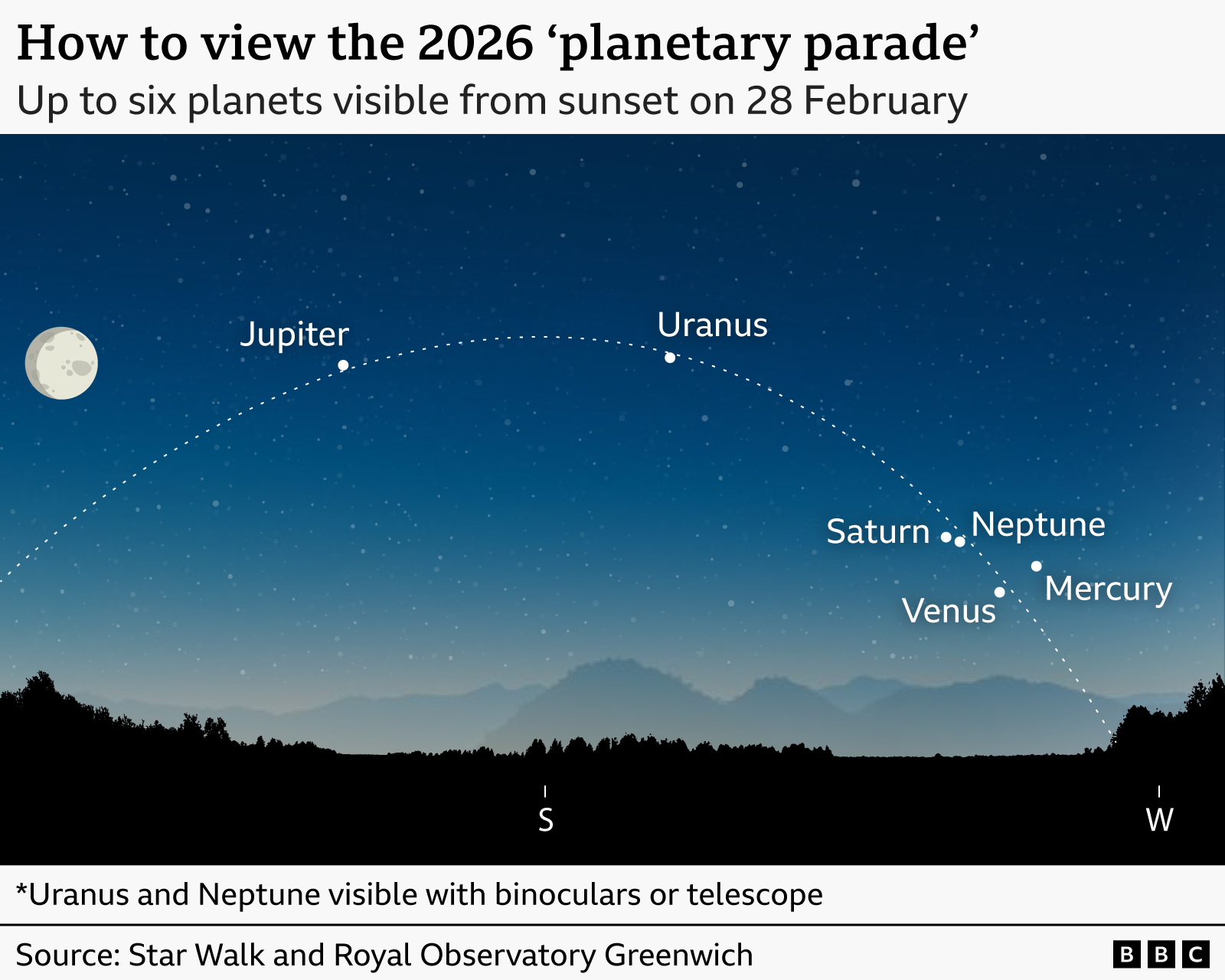
If you missed the alignment at the very end of February, the first week of March still offers a rare chance to see a planetary line-up stretching across the ecliptic.
- The Targets: Mercury, Venus, Saturn, and Neptune will be low on the western horizon just after sunset. Jupiter and Uranus will be hanging higher in the sky.
- The Challenge: While Venus and Jupiter are easy naked-eye targets, Neptune and Uranus are the real "telescope trophies."
- Telescope Tip: Hunt for Neptune’s tiny blue disk about 1° northwest of Saturn on March 7th. You’ll need a steady hand and at least a 4-inch aperture to distinguish its non-stellar appearance.
3. The Venus-Saturn Conjunction (March 7–8)
On the evenings of March 7 and 8, the "Evening Star" (Venus) will make an exceptionally close approach to the "Ringed Planet" (Saturn).
- The View: They will be less than 1° apart, close enough to fit within the same field of view in many telescopes.
- The Detail: While Venus will show a nearly full, 97%-lit disk, Saturn’s rings will be tilted at a narrow angle, offering a unique "thin-ring" profile that is a favorite for astrophotographers.
4. Deep-Sky "Dark Window" (New Moon: March 19)
The New Moon on March 19th provides the perfect "dark sky" conditions SkyMapper nodes love. With no lunar glare, it’s the best time to point your SkyBridge-enabled scopes at faint fuzzies.
- Key Targets: * The Beehive Cluster (M44): A stunning open cluster in Cancer that explodes into hundreds of stars through a telescope.
- Uranus & the Pleiades: Uranus will be hovering just south of the M45 (Pleiades) cluster all month. On March 15, look for it just 12′ south of the star 13 Tauri.
5. Jupiter & the Galilean Dance (March 26–27)
Jupiter remains a dominant force in the constellation Gemini all month.
- The Event: On March 26, the Moon and Jupiter will share the same right ascension (a conjunction).
- The Detail: Use your high-magnification eyepieces to track the Galilean moons. On the night of March 26/27, watch for a Europa transit, where the icy moon and its shadow march across the Jovian cloud belts.
Join the Global Map
At SkyMapper, we’re not just watching the sky; we’re documenting it. Every time you point your telescope at these events, you’re part of a global effort to create a verifiable, real-time map of our universe.
Don't have clear skies? Log into the SkyViewer platform to watch live streams from other telescopes in our decentralized network. If your local horizon is cloudy for the eclipse, someone else in the SkyMapper community will have it in their sights.
Pull out the scope, align your mirrors, and let’s map the "now" together.
Clear skies!, The SkyMapper Team
SZ3 2026