July 2026 brings an observational changing of the guard. As the dazzling evening geometry of the inner planets flattens toward the horizon, the SkyMapper network shifts its focus. The mid-summer nights in the north open up a dark-sky highway directly into the heart of our galaxy, while southern nodes continue to exploit pristine, freezing winter nights.
This month’s mission briefing for the compatible Unistellar scopes (eVscope and eQuinox arrays) targets extreme planetary alignments, glowing planetary nebulae, and high-velocity meteor smoke. Charge your batteries, update your coordinates, and let's map the mid-summer cosmos.
1. The Pre-Dawn Ultra-Close Alignment: Mars & Uranus (July 4)
Visibility: Global (Best in the East-Northeast before dawn)
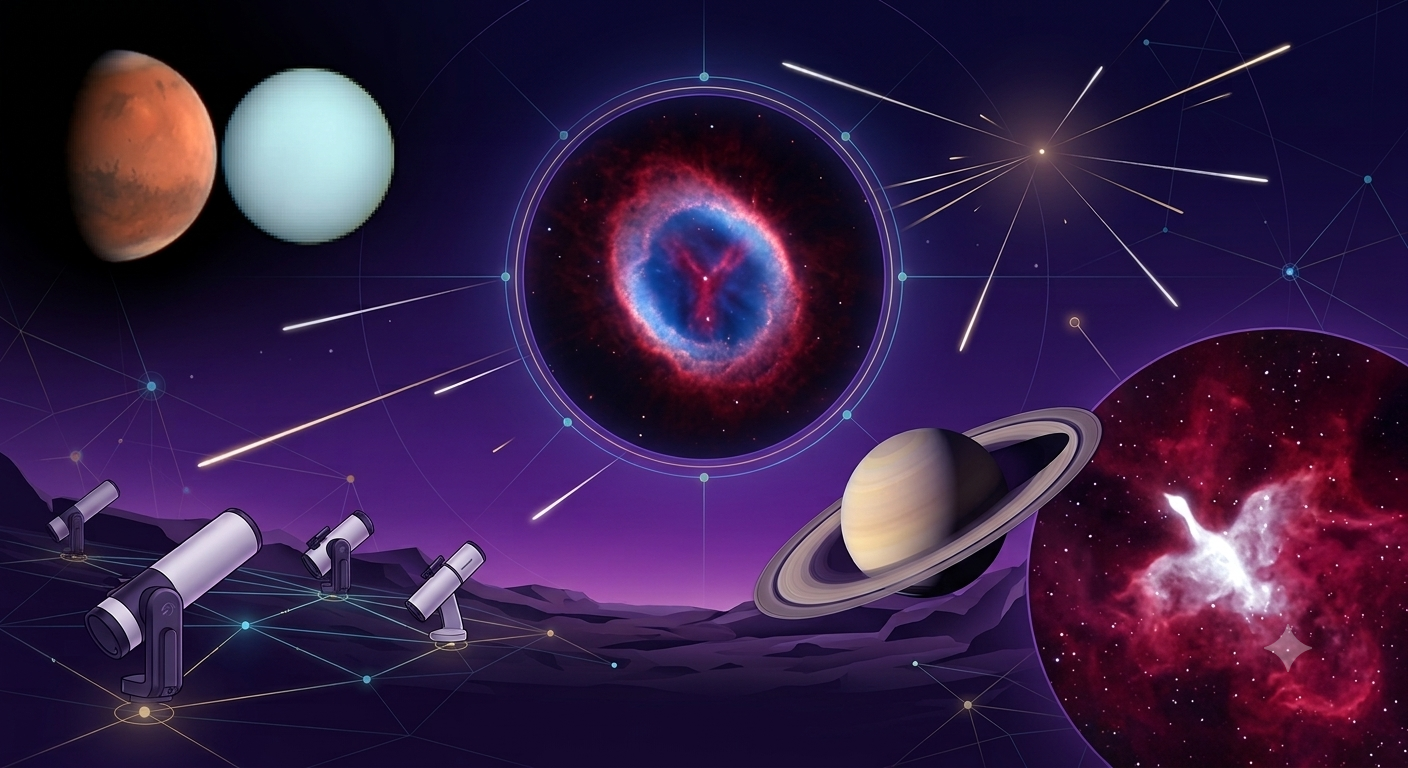
Independence Day kicks off with an incredible test of your smart telescope's resolving optics. In the early morning hours of July 4, the Red Planet (Mars) passes just 9.6 arcminutes away from the ice giant Uranus. They are so close they will easily share the exact same field of view.
- The View: The distinct, fiery ochre glow of Mars sits right next to the pale, soft aquamarine disk of Uranus.
- Unistellar Advantage: Hunting for Uranus in morning twilight can be incredibly frustrating for manual setups, but your Unistellar scope’s autonomous field detection will lock onto the coordinates instantly.
- Smart-Scope Tip: Use manual gain control in your app to dial down the exposure slightly. This ensures Mars doesn't bloom and overwhelm the delicate, faint blue-green pixel structure of Uranus right beside it.
2. Northern Hemisphere Spotlight: The Ring Nebula (M57)
Visibility: Northern Hemisphere (High Overhead at Midnight)
With the New Moon arriving on July 14, the dark-sky window is pristine. Northern nodes are directed to lock their sensors onto the constellation Lyra to map one of the most famous cosmic artifacts in the galaxy: Messier 57 (The Ring Nebula).
- The Target: A glowing barrel of gas shed by a dying star thousands of years ago, located 2,300 light-years from Earth.
- Unistellar Advantage: Enhanced Vision mode shines here. While a traditional eyepiece shows a faint, grey ghostly donut, your smart telescope's digital stack will steadily reveal the intense ionized gas rings, vivid blues and greens near the hot central white dwarf star, bleeding into deep crimson reds along the outer shockwave.
- The Grid Mission: Let your scope accumulate photons for at least 30 minutes to capture the outer halo structures for the SkyMapper data stream.
3. Southern Hemisphere Spotlight: The Swan Nebula (M17)
Visibility: Southern Hemisphere & Tropics (High Overhead)
For our southern network nodes enjoying deep, crisp winter tracking windows, July offers the ultimate look at the galactic core. Your primary deep-space target is Messier 17 (The Swan or Omega Nebula) in Sagittarius.
- The Target: A colossal star-forming factory found inside the dense lane of the Milky Way, where hot young stars illuminate sweeping structures of interstellar dust.
- Unistellar Advantage: The deep light-pollution reduction algorithms embedded in your eQuinox or eVscope will cleanly slice through the background starlight of the galactic core. The resulting images reveal a brilliantly defined, glowing "swan" silhouette floating on a sea of deep red emission nebulosity.
4. Extreme Tracking Challenge: The Return of Saturn's Rings (All Month)
Visibility: Global (Visible past midnight, highest before dawn)
After a difficult viewing season last year where Saturn's rings appeared nearly edge-on, July 2026 sees the Ringed Planet rising much higher in the pre-dawn sky, with its ring system now tilted much more favorably.
- The View: The negative tilt means Saturn's southern hemisphere is angled toward Earth, providing an incredibly sharp, clean look at the shadow cast by the planet onto its own rings.
- Smart-Scope Tip: Saturn reaches a stable 30° altitude by the end of the month in the southeast. Switch your Unistellar scope into its high-framerate "Planetary Mode" with the Enhanced Vision button, which keeps your tracking active during moments of stable atmospheric "seeing" to map out cloud bands on the gas giant's surface.
5. Mid-Month Cosmic Meetup: Venus & Regulus (July 9)
Visibility: Global (Low in the Western Horizon after sunset)
On the evening of July 9, the dazzling "Evening Star" (Venus) will pass just under 1 degree north of Regulus, the anchor star and "heart" of the Leo constellation.
- The View: This offers a brilliant color contrast. Venus will shine like a white diamond at magnitude -4.0, side-by-side with the crisp, blue-white light of Regulus.
- Unistellar Tip: Because the ecliptic angle is quite shallow this month, both objects will sink quickly after sunset. Set up early and begin capturing as soon as twilight deepens to grab clean frames before atmospheric distortion worsens near the horizon.
The July Network Directive: Capture the Fire
Toward the very end of the month (July 30–31), the Southern Delta Aquariid meteor shower peaks. While our telescopes won't chase the fast-moving streaks, we want our global network arrays pointing toward the radiant in Aquarius to document any lingering ionized dust trains or upper-atmospheric "smoke" left behind by fireballs.
- Automated Data Contribution: By targeting M17 or M57 during the New Moon on the 14th, your smart scope automatically validates data blocks for our blockchain-verified star maps.
- Clouded Out? If mid-summer storms roll over your node, log into the SkyViewer portal to access live, low-latency stacked data streams from across our global decentralized array.
Dust off your tripods, level your optics, and let’s map the summer sky together.
Clear skies!
— The SkyMapper Team