August brings a peak operational window for the SkyMapper network. Long, warm summer nights in the Northern Hemisphere coincide with the absolute best deep-sky conditions of the year, while our Southern Hemisphere nodes continue to leverage deep winter skies to track targets near the galactic center.
With the Unistellar fleet (eVscope and Odyssey arrays) locked onto our decentralized ledger, August 2026 presents a high-octane mix of annual meteor surges, ringed planet geometry, and brilliant emission nebulae. Ensure your tripods are level, calibrate your field orientation, and let’s map the August sky.
1. The Headliner: The Perseid Meteor Shower Peak (August 12–13)
Visibility: Global (Best in the Northern Hemisphere after midnight)
The Perseids are the most celebrated meteor shower of the year, known for producing fast, brilliant fireballs and persistent ionized dust trains as Earth sweeps through debris left behind by Comet Swift-Tuttle.
- The View: While meteors zip across the sky to the naked eye, smart telescopes play a specialized role during the peak.
- Unistellar Tip: Focus your smart scope on the region around the radiant in Perseus or toward rich star fields nearby. By running continuous short-exposure observations, nodes can capture high-resolution imagery of lingering meteor persistent trains, the glowing, ionized smoke left behind by larger fireballs, providing valuable atmospheric data for our global map.
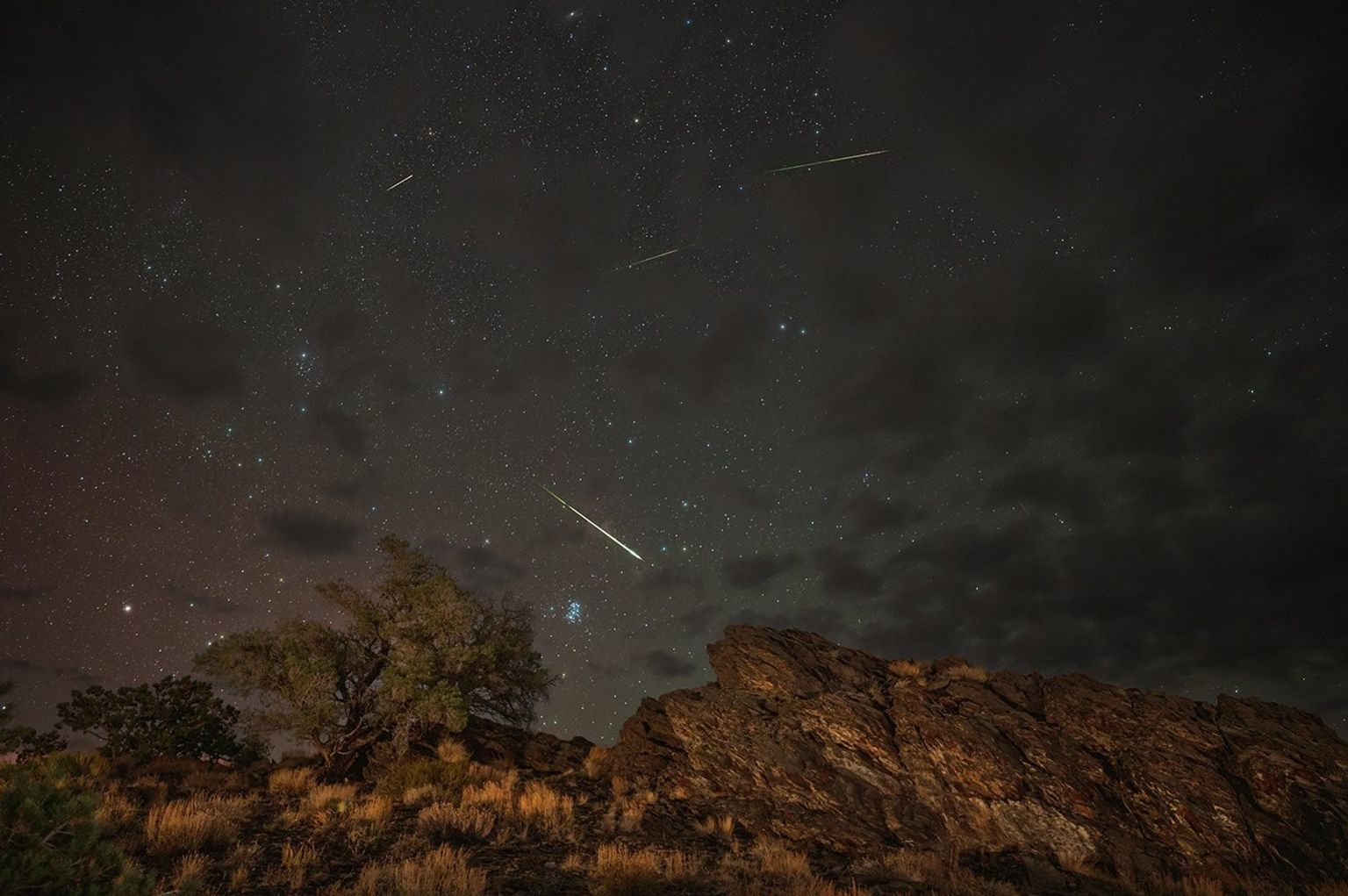
Meteors from the Perseids Meteor Shower streak across a partly cloudy sky above Inyo National Forest in Bishop, California, in 2024. Source: NASA/Preston Dyches
2. Northern Hemisphere Spotlight: The Dumbbell Nebula (M27)
Visibility: Northern Hemisphere & Tropics (High Overhead at Midnight)
With the New Moon arriving on August 12, perfectly aligned with the Perseid peak, dark-sky imaging is at an all-time premium. Northern observers are directed to target Messier 27 (The Dumbbell Nebula) in Vulpecula.
- The Target: The very first planetary nebula ever discovered, M27 is an expanding shell of gas cast off by a dying star, located roughly 1,360 light-years away.
- Unistellar Advantage: Traditional visual scopes often show M27 as an apple-core-shaped haze. Your Unistellar telescope’s Enhanced Vision mode will slice through the darkness, stacking photons to reveal vibrant teal oxygen emission cores surrounded by delicate red hydrogen wings and subtle outer envelopes.
3. Southern Hemisphere Spotlight: The Lagoon Nebula (M8)
Visibility: Southern Hemisphere (High Overhead)
For our southern nodes, August offers prime viewing of the Sagittarius constellation as it rides high in the night sky. The high-priority target for network ledger contributions is Messier 8 (The Lagoon Nebula).
- The Target: A colossal interstellar cloud classifying as both an emission nebula and an H II region, bursting with young, hot stars and dark dust lanes (Bok globules).
- Unistellar Advantage: The deep sky contrast algorithms on your eVscope or Odyssey will isolate the winding dark lane, the "lagoon", that cuts straight through the glowing heart of the nebula, delivering crisp, publication-grade imagery directly to your connected app.
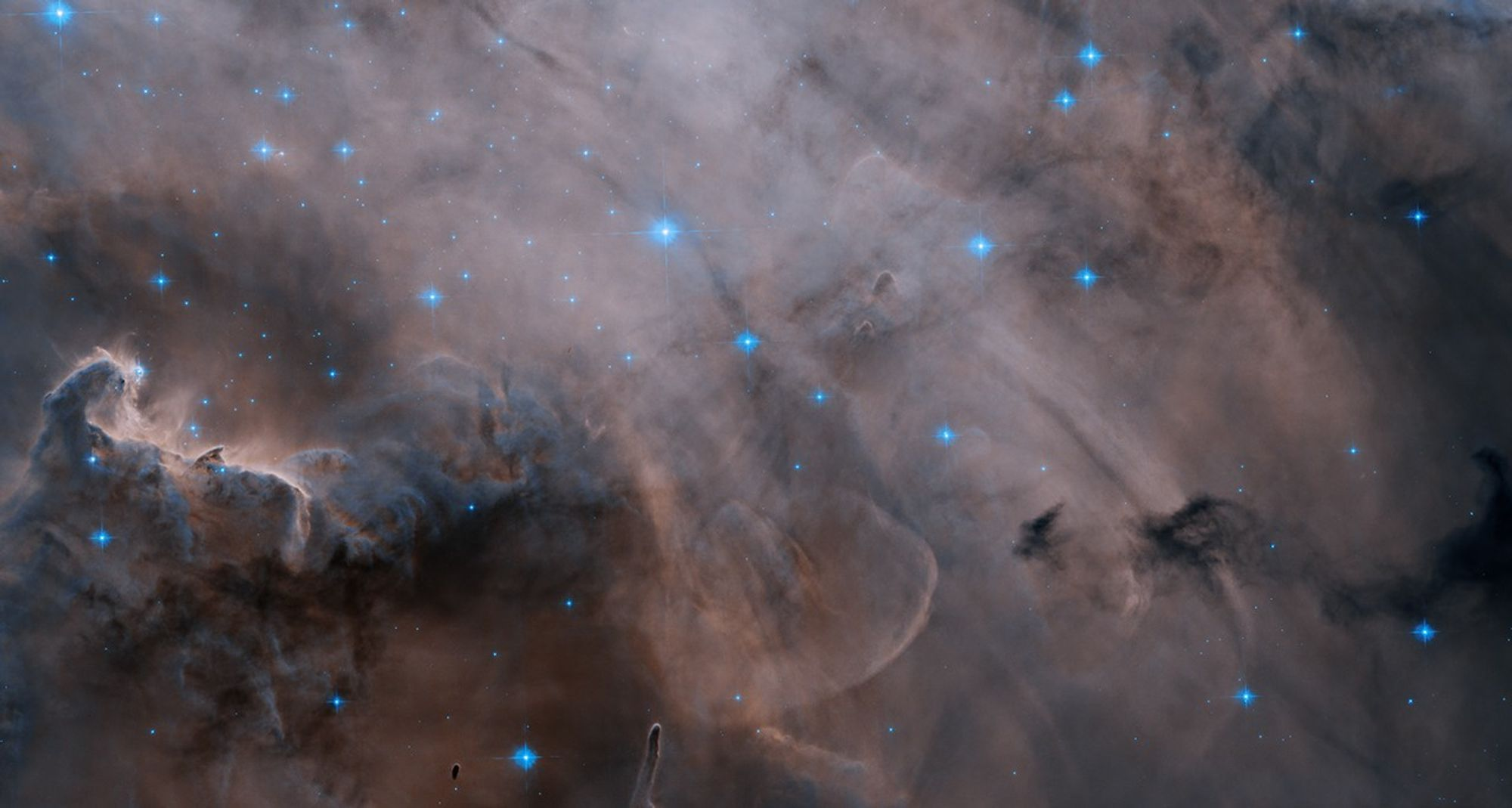
Pictured here are clouds of gas and knots of dark dust strewn with a scattering of bright blue stars in this Hubble image of a portion of M8. Source: NASA, ESA, M. Mutchler (Space Telescope Science Institute); Processing: Gladys Kober (NASA/Catholic University of America)
4. Planetary Focus: Saturn Nears Prime Geometry (All Month)
Visibility: Global (Rises in the East after Sunset, High at Midnight)
Saturn is fast approaching its September opposition, making August the premier month to map the gas giant as it dominates the late-evening hours.
- The View: With its rings tilted back open toward Earth at a favorable angle, Saturn's disk casts a sharp, distinct shadow onto the ring plane behind it.
- Smart-Scope Tip: On nights of steady seeing, capture Saturn to map the subtle shade variations across its equatorial cloud bands and resolve the dark Cassini Division running through the rings.
5. Mid-Month Alignment: Mercury at Greatest Eastern Elongation (August 28)
Visibility: Global (Low in the Western Horizon at Dusk)
To cap off the month, Mercury reaches its farthest separation from the Sun in the evening sky, offering smart scope users a rare window to lock onto the solar system's innermost world.
- The View: Through your telescope, Mercury will display a sharp crescent phase, glowing brightly against the fading twilight.
- Smart-Scope Tip: Because Mercury sits low in the evening glow, initiate tracking as soon as twilight permits. Keep exposure settings low to prevent the bright sky background from washing out the sharp crescent edge of the planet.
The August Network Directive: Map the Streams
August combines prime planetary geometry with the dark-sky windows necessary for deep-space mapping. Whether you are capturing the ionized gas of M27, tracking the rich core details of M8, or recording dust trails during the Perseid peak, every frame stacked on your Unistellar device strengthens the SkyMapper decentralized ledger.
- Clouded Out? If summer storms roll through your area, log onto the SkyViewer portal to access live, low-latency stacked data streams from other operational nodes across the global array.
Level your tripods, launch the app, and let’s map the stars.
Clear skies!
— The SkyMapper Team
sz326