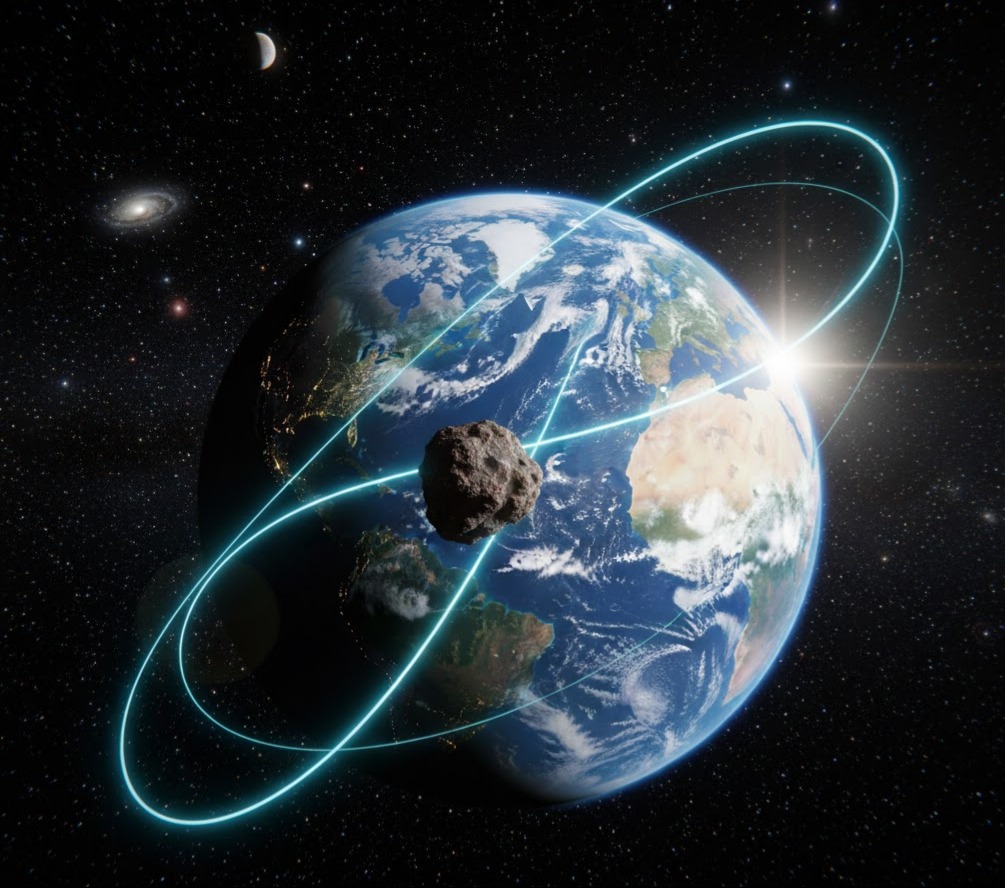
Here at SkyMapper, we’re always tracking the most interesting cosmic companions in our neighborhood. And Earth just gained a spectacular, though temporary, new friend: the asteroid designated 2025 PN7, a member of the Arjuna asteroid class. Dubbed by some as a "quasi-moon," this small object has been quietly following us for decades, and its recent confirmation as a quasi-satellite offers astronomers a rare window into orbital mechanics.
What is a Quasi-Satellite?
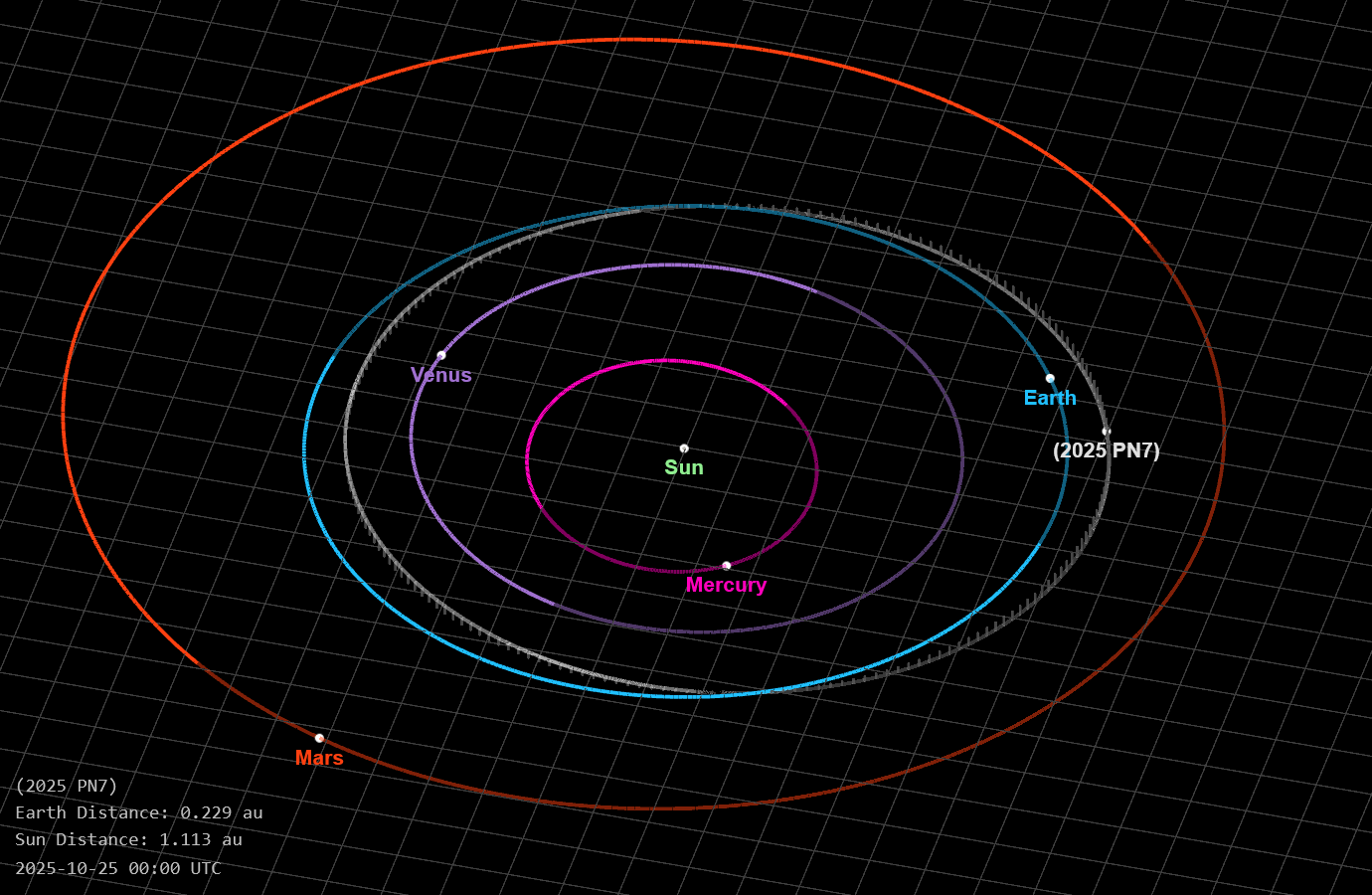
Despite the exciting headlines, 2025 PN7 is not a true moon like our permanent, tide-tugging companion. A quasi-satellite is an asteroid that orbits the Sun, not the Earth, but maintains a delicate 1:1 orbital resonance with our planet. Think of Earth and 2025 PN7 as two synchronized swimmers who complete a lap in the exact same time but never hold hands.
The asteroid's solar orbit is almost identical to Earth's, giving it an orbital period of just about 365 days. However, minor differences in its path cause it to trace a wide, looping trajectory around our planet when viewed from Earth's perspective, an orbital handshake that lasts for centuries.
The Discovery and the Arjuna Class
The existence of this companion was confirmed following observations by the Pan-STARRS 1 telescope in Hawaii in August 2025.
2025 PN7 belongs to the Arjuna asteroid class, a population of Near-Earth Objects (NEOs) whose orbits closely resemble Earth's. These objects have low eccentricities and low inclinations, making them the ultimate cosmic followers. The research of de la Fuente Carlos details that this asteroid has been in its current quasi-satellite configuration since the 1960s.
- Size: Roughly 19 meters (62 feet) in diameter—about the size of a city bus.
- Brightness: Asteroid 2025 PN7 is rated as magnitude 26, making it extremely dim and far too faint to be seen with the naked eye or amateur equipment.
- Safety Check: It poses absolutely no threat to Earth. Its closest approach is still about 10 times the distance between the Earth and the Moon.
A Stable Companion Until the 2080s
One of the most fascinating findings of the research is the stability of its orbit. While mini-moons are temporarily captured by Earth's gravity for only a few months, 2025 PN7 is expected to remain in this resonant dance with Earth until the 2080s.
This long-term residency makes it a critically valuable subject for study. By tracking its movement, astronomers can gain insights into:
- Orbital Dynamics: How small, non-gravitationally bound objects interact with large planets.
- Solar System History: The origins of the Arjuna population and how Earth’s gravity influences the path of passing asteroids.
- Future Missions: Due to its proximity and stable, Earth-like orbit, quasi-satellites are sometimes considered easier targets for potential future space missions or resource utilization studies than more distant asteroids.
The discovery of 2025 PN7 highlights how dynamic our local cosmic neighborhood truly is. As new research continues to track and model the orbits of these quasi-satellites, SkyMapper will continue to bring you the latest on fascinating space rocks like this.
Contact us if you have any questions or would like us to post about your favorite phenomena.
SZ3 2025