.jpg)
Today, we are spotlighting an incredible astronomical feat that requires not only specialized gear but also a staggering amount of precision and patience.
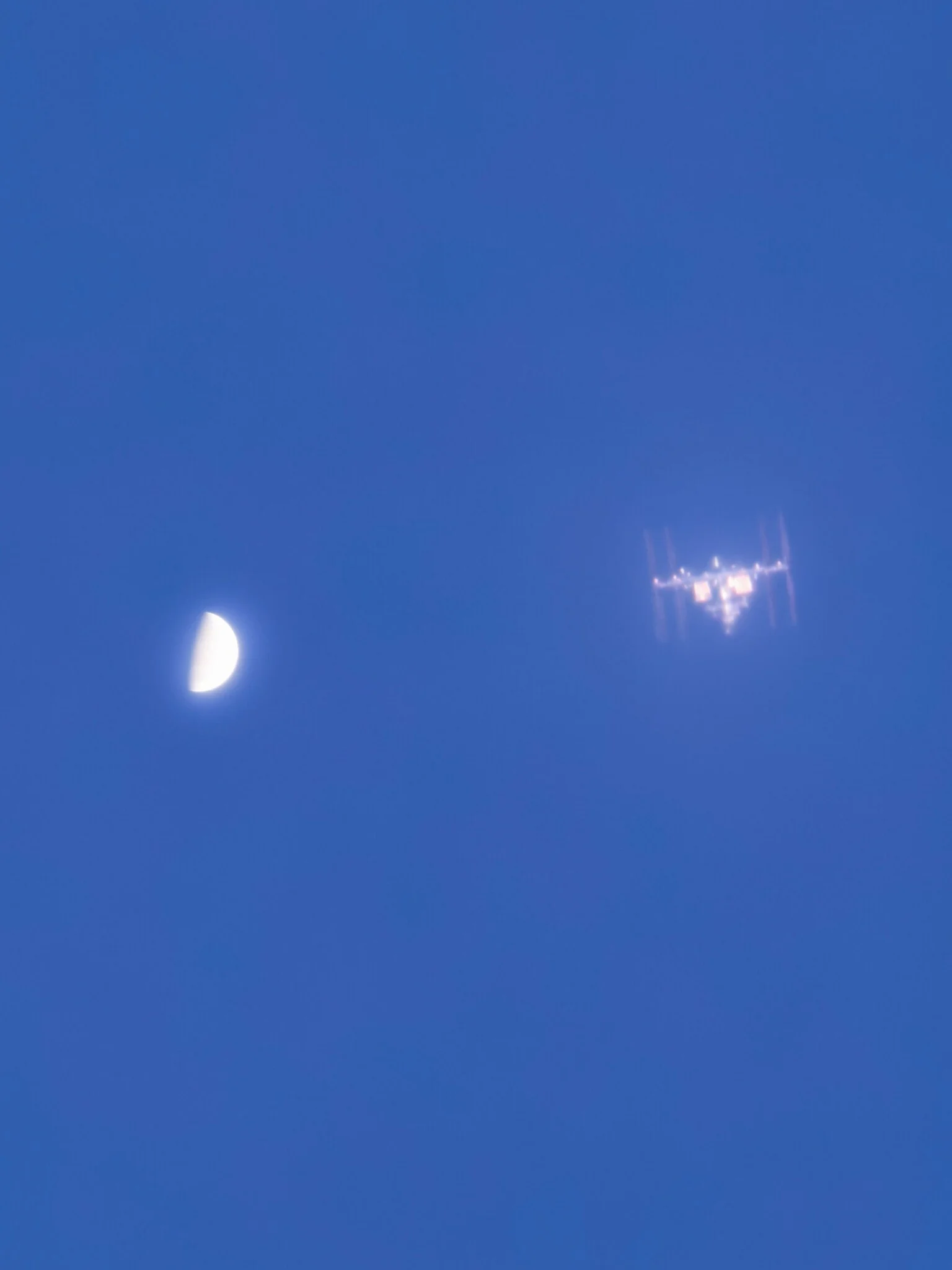
Photographer AJ Smadi recently accomplished something most of us can only dream of: capturing the International Space Station (ISS) and the planet Venus together in a single frame. Incredibly, this is only the second time this feat has been photographed, and Smadi was the one who captured the first instance as well, as detailed in the original article on PetaPixel.
The Cosmic Intercept
The spectacular cosmic alignment took place on a Saturday evening at 6:38 p.m. above a park in Edmonds, Washington. From Earth's perspective, capturing the ISS passing in front of another celestial body requires immense preparation. Because the space station hurtles through low Earth orbit at a mind-boggling 7.5 kilometers per second, the window for capturing a transit is often just a fraction of a second. Smadi had to plan his vantage point down to the exact meter to ensure everything lined up perfectly.
Adding to the visual magic of the shot is the phase of Venus. Similar to our Moon, Venus goes through phases depending on its position relative to the Sun. Having recently emerged from behind the Sun, the planet appeared just over half-illuminated in the sky.
A Trick of Perspective
When looking at the final image, the ISS and Venus appear remarkably similar in size. However, this is a brilliant trick of cosmic perspective! In reality, Venus is roughly the same size as Earth, while the ISS is only about the size of a football stadium. The illusion is made possible by the 135 million-kilometer distance stretching between the two objects.
The Gear Behind the Magic
For the gearheads here at SkyMapper.io, you are probably wondering what equipment makes a shot like this possible. Smadi relied on a heavy-duty setup to ensure clarity and precision, utilizing a 9.25-inch Celestron Schmidt-Cassegrain telescope with a 2,350mm focal length. He paired this with a ZWO ASI662MC camera featuring a Sony IMX662 sensor, and attached a UV/IR cut filter to block out ultraviolet and infrared light interference.
To freeze the fast-moving space station, Smadi shot an uncompressed video utilizing a fast 1/150 of a second exposure. This technique allowed him to grab 10 distinct frames of the transit, which he then stacked together in post-processing to bring out as much sharp detail as possible.
How to Capture This on the SkyMapper Network with a Unistellar Telescope
For amateur astronomers on the SkyMapper network looking to attempt a similar capture using a Unistellar telescope, first ensure your system meets our platform's connectivity specifications outlined on the SkyMapper telescope requirements page. Once you are ready, consult an online prediction tool to find the exact geographical path and time of an upcoming ISS transit across a bright celestial object like Venus or the Moon. After setting up your Unistellar telescope at that precise location, use the companion app to autonomously slew to and track your target.
Because the space station travels incredibly fast, you must step away from the automatic deep-sky stacking features and switch over to manual mode. Drop your exposure time to its absolute minimum and adjust the gain so the target planet is clearly visible but not completely overexposed. Since the Unistellar app relies on longer exposure stacking rather than high-speed video burst modes, your best strategy is to start a high-quality screen recording of your smart device's live view a few moments before the station is scheduled to fly through the frame.
Whether you are tracking transits or shooting deep-space nebulae, AJ Smadi’s phenomenal work is a testament to what is possible with meticulous planning. Keep your eyes on the skies, and until next time, clear skies from all of us at SkyMapper.io!