A global community of observers can reshape astronomy, strengthen space safety, and build a trusted sky for everyone.
Our view of the universe has been limited to wherever the nearest observatory happened to be. Professional telescopes were once scarce, isolated, and dependent on institutions with the resources to build and maintain them. Despite extraordinary global technological accessibility, the world still relies on a relatively small number of professional observatories to understand a sky that continues to change. Space science in its current state, is centralized.
This crucial realization must face the fact that the sky doesn’t sleep. Objects move. Satellites flare. Space debris shifts. Comets brighten and fade in hours. Asteroids pass through the observational blind spots between continents. The pace of activity above us has accelerated far beyond the pace at which traditional observatories can respond.
We live in a dynamic, orbital era. Our current centralized tools and methods have repeatedly missed critical observations, and the world needs something fundamentally new—a decentralized, global network to ensure complete sky coverage.
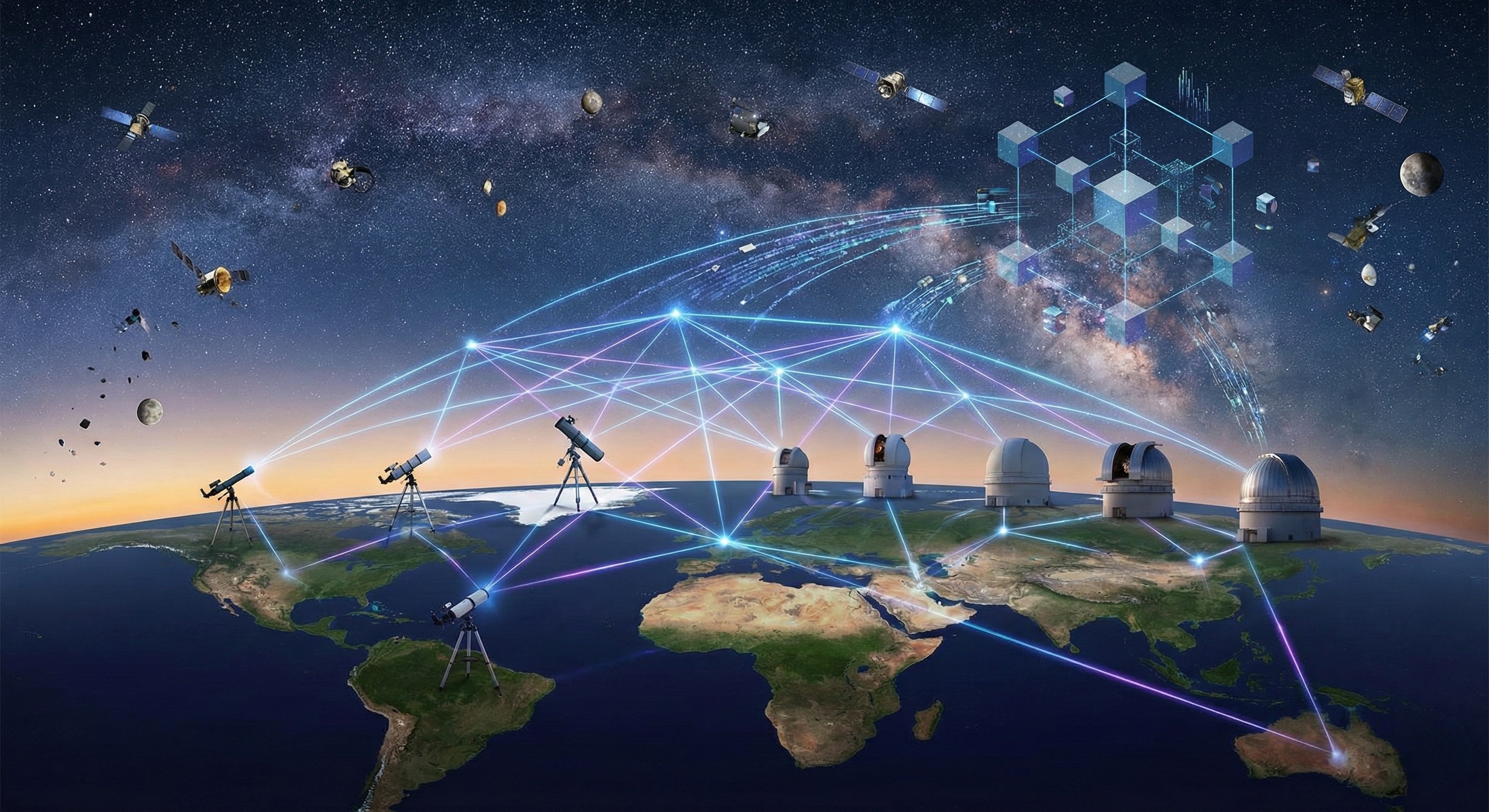
The future of astronomy lies in a decentralized, global telescope network. This new model moves beyond isolated observatories, instead leveraging the combined power of thousands of connected instruments operating collaboratively, continuously, and transparently. In this network, anyone, from a citizen astronomer to a university lab, can contribute their telescope to create a real-time, worldwide map of the sky.
The Problem: We Only See Part of the Sky, Part of the Time
Even the most advanced observatories face three unavoidable limitations:
- Geography —The telescope is restricted to observing the sky solely from its established location.
- Weather — Atmospheric conditions like clouds, humidity, and other anomalies frequently obstruct observations at a single location, often frustrating the carefully laid plans for research that may have taken years to prepare.
- Time — No single observatory can continuously monitor the entire sky. A network of decentralized telescopes grants astronomers consistent, diverse observational access, extending beyond local nighttime hours.
These significant observational gaps, particularly over oceans, rural areas, the Southern Hemisphere, and during nighttime transitions, create critical blind spots. Our inability to observe these areas hinders our efforts to:

- Track satellites and space debris
- Detect transient astronomical events
- Validate scientific observations
- Monitor near-Earth objects
- Support missions and launches
- Provide real-time situational awareness in orbit
Space is getting crowded fast. Tens of thousands of satellites and fragments of defunct satellites now fill low Earth orbit. Without persistent, distributed monitoring, operators risk mission failures, collisions, and cascading debris scenarios that threaten every satellite we depend on.
The sky is becoming too important, and too congested to be monitored by a few isolated eyes.
The Solution: A Decentralized, Community-Powered Sky
SkyMapper’s decentralized telescope network turns a global challenge into a global opportunity.
We possess tens of thousands of existing telescopes; rather than constructing more solitary observatories, the path forward is to unify these assets into a coordinated, intelligent, and verifiable global observation layer.
This network is:
Global
Because telescopes are anywhere people live, urban and rural, North and South, East and West.
Continuous
When one telescope is clouded out, another is clear. When one region is asleep, another is waking up.
Decentralized
A network built by its users, free from any single point of failure or central authority, puts the sky back in the hands of the people.
Intelligent
AI and predictive tools offer two key capabilities for the decentralized telescope network: real-time routing of observation tasks to optimally positioned telescopes and keeping users informed about the data being gathered by the network.
Trustworthy
Data is verifiable, timestamped, and secured using blockchain-backed technology.
Observations are immutable, crucial for science and space safety and security.
Community-Powered
Every telescope owner becomes part of a global mission.
Every participant contributes to humanity’s understanding of the sky.
This is not science for the few, this is science for all.
Why It Matters: Science, Safety, and Shared Discovery
A decentralized telescope network unlocks new capabilities that previously required government-scale infrastructure.
1. Better Science
Transient events, supernovae, comets, occultations, often last only minutes or hours.
With global coverage, we can capture them from multiple angles, continuously.
2. Space Domain Awareness
Tracking satellites and debris becomes easier, faster, and more accurate when observations come from hundreds of perspectives, not just a handful.
3. Democratized Discovery
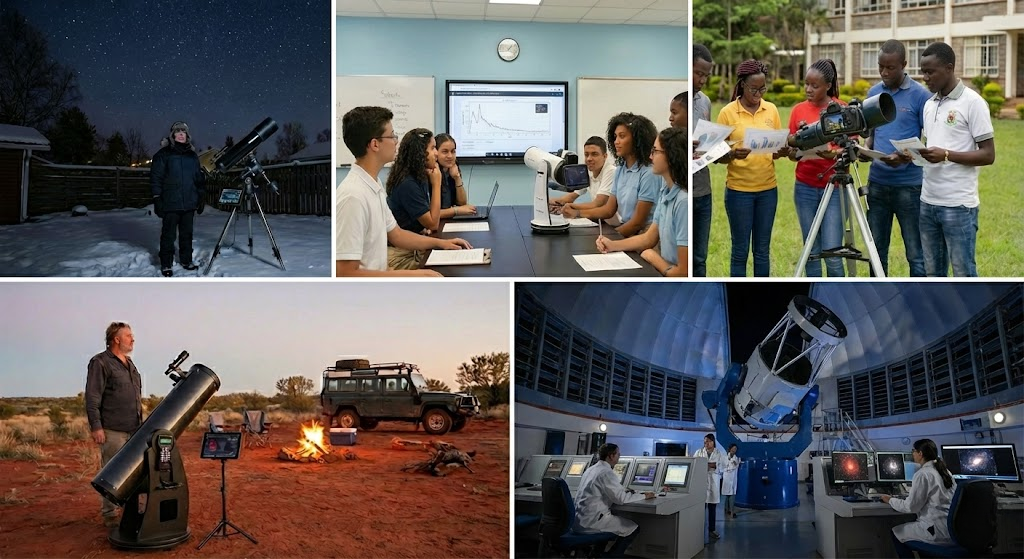
Leveling the playing field for scientific participation brings value and efficiency. The next major discovery might come from a backyard astronomer in Finland, a school in Puerto Rico, a telescope owner in the Australian outback, or a university club in Kenya.
4. Data Integrity and Transparency
By securing observations through decentralized storage and provenance systems, the data becomes independently verifiable and trustworthy, foundational for research, space traffic management, and future autonomous systems.
5. Resilience
In a decentralized network, no single failure, technical, political, or environmental can shut down the sky.
This Is the Moment
The tools now exist:
- Affordable smart telescopes
- Cloud-connected astronomy software
- Decentralized storage solutions
- Blockchain-backed data verification
- AI-driven prediction and routing
- Global communities united by curiosity
For the first time in history, we can build a unified observing layer for planet Earth, not owned by governments, not limited to institutions, but powered by the world itself. This network is where every telescope matters and every observer becomes a contributor. In this network, we are closer to the sky and to each other.
The world doesn’t just need better telescopes. It needs a decentralized telescope network.
SkyMapper is building it globally, with professional and citizen astronomers alike.
SZ3 2026